
Bell 204 UH-1B Huey Helicopter Silhouette Patch
- SKU:
- 4462
- MPN:
- 4462
- Width:
- 4.12 (in)
- Height:
- 1.62 (in)
- Depth:
- 0.08 (in)
- Backing:
- Iron On
- Edging:
- Merrowed Edge
- Era:
- Vietnam War


Description
The Huey got its name from a designation the Army dropped in 1962: the Bell helicopter entered service as the HU-1, and the letters turned into a name that stuck. Even after it became the UH-1 Iroquois, nobody called it that, and Bell eventually cast "Huey" right into the anti-torque pedals. The Bell Model 204 began as the XH-40, which first flew on 20 October 1956 at Fort Worth, Texas, with Bell's chief test pilot Floyd Carlson at the controls. The UH-1B was the version that took the design from a promising transport to the workhorse of a new kind of Army. This patch puts that profile on its own, nothing but the helicopter.
The UH-1B was an upgraded HU-1A with external and rotor improvements and a Lycoming T53-L-5 engine rated at 960 shaft horsepower. Its longer cabin carried seven passengers or four stretchers and a medical attendant. Army testing began in November 1960 and the first production aircraft were delivered in March 1961, with 1,014 B models built. Hueys with the 57th Medical Detachment arrived in South Vietnam in March 1962. Armed B models flew as gunships, but the extra weight left them short of power to keep up with the transports, which led to the UH-1C, and the Army later refitted every UH-1B with the 1,100 shaft horsepower T53-L-11. The stretched Model 205, the UH-1D and UH-1H, followed with a cabin 41 inches longer.
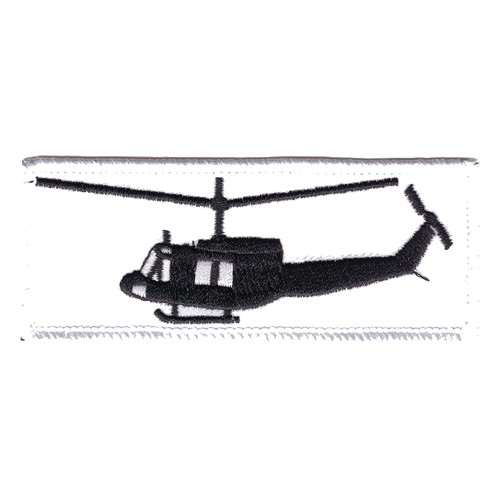
This is a 4.12 by 1.62 inch horizontal patch with a white twill field and a white merrowed edge. A black Huey crosses it in profile, nose to the left, with the two-blade main rotor reaching nearly edge to edge. White thread picks out the cockpit glass at the nose and the windows of the cabin behind it. The tail boom runs out to the tail rotor at the upper right, and the skids sit level beneath. There is no lettering, just the silhouette any helicopter man knows at a glance, and the back is iron-on.
For soldiers of the Vietnam era, the Huey was the ride in, the ride out, the resupply and the medevac. Pilots, crew chiefs and door gunners flew it, and infantrymen counted on it, often in the same afternoon. The sound of those two rotor blades is still the first thing many veterans remember about the war. The B model was there early, when the Army was still working out what helicopters could do in combat, and its gunship lessons shaped the aircraft that came after. A plain black silhouette is enough to bring all of that back.
It fits a shadow box with aircrew wings and a photo from the flight line, or the shoulder of a jacket or flight bag. It is also a good gift for a father who flew or crewed Hueys, or for a grandson who builds the model kits. Press it on, stitch the edge, and it stays. One shape, instantly known.
Related Products


