
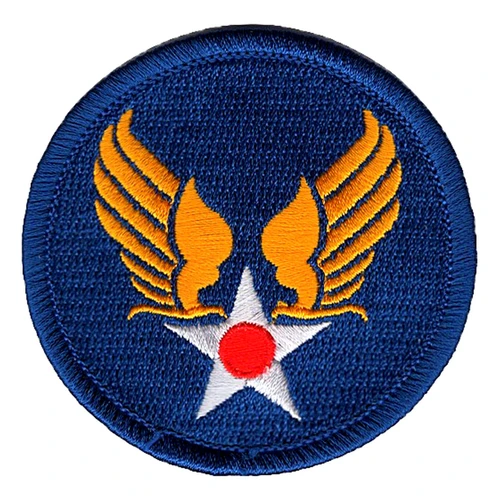
Army Air Forces WWII Hap Arnold Emblem Shoulder Patch
- SKU:
- 6056
- MPN:
- 6056
- Width:
- 2.50 (in)
- Height:
- 2.50 (in)
- Depth:
- 0.08 (in)
- Backing:
- Iron On
- Edging:
- Merrowed Edge
- Era:
- World War II


Description
The wings on this patch turn upward in a V because James T. Rawls, an artist on Hap Arnold's staff, drew them from Winston Churchill's V for Victory sign, and Arnold looked at the sketch and said, "That's just what I wanted." Arnold had already turned down Rawls's earlier designs. The winged star was approved on February 23, 1942, for all personnel of the Army Air Forces wherever they were stationed. Plenty of people still call it the Hap Arnold emblem, after the general who commanded the AAF through World War II. Arnold had a hand in wings before: he is reported to have designed the first Army pilot wings in 1917, as a major.
The Army Air Forces was created on June 20, 1941, and by March 31, 1944, it had about 2.41 million people in uniform. In July 1944 it had roughly 80,000 aircraft, from B-17 Flying Fortresses and B-24 Liberators to P-38 Lightnings, P-47 Thunderbolts and P-51 Mustangs, with B-29 Superfortresses carrying the war to Japan. It fielded 318 combat groups over the course of the war and had sixteen numbered air forces by the end, the Eighth, Fifteenth and Twentieth among them. On March 2, 1943, the overseas air forces were authorized patches of their own, and from June 25 of that year every air force could wear one. The AAF was abolished on September 18, 1947, when the U.S. Air Force became a separate service.
The patch is round, 2.5 inches across, with a blue merrowed edge around an ultramarine twill field. A white five-pointed star sits low in the circle with a red disk at its center, and two golden wings rise from it at a 45 degree angle. The blue stands for the sky the Air Forces fought in, and the gold wings for victorious operation. The white star with a red center had marked Army and Navy airplanes since 1921, and the red disk came off aircraft in 1942 so it could not be mistaken for the Japanese marking. On this patch the red disk stays, the way the design looked when it was approved.
In 1942 the same circle went on the shoulder of a B-17 waist gunner, a crew chief on the line and a clerk at a training field stateside. It was the patch of the generation that built American air power from a few thousand airplanes into the force that flew over Germany and Japan. The men who wore it brought its habits into the new Air Force in 1947. The winged star still appears today on U.S. Air Force uniform buttons. Many families have one of these patches in a drawer, cut from a grandfather's Ike jacket.
Put it in a shadow box beside a grandfather's wings, discharge papers and a photo by his airplane, or on a vest for a WWII aviation reunion or airshow. It also makes a good gift for a grandson who wants to know which outfit the old man flew with. It irons on and can be sewn on as well. Eighty years on, the winged star is still the mark of the Army Air Forces.
Related Products


