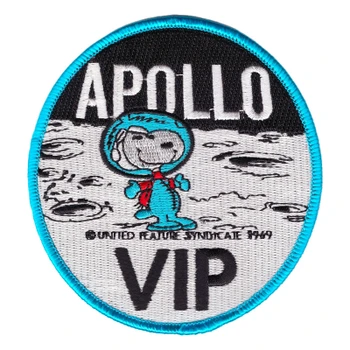
Apollo VIP Black Border Beagle Astronaut Moon Patch
- SKU:
- 9179
- MPN:
- 9179
- Width:
- 3.75 (in)
- Height:
- 4.00 (in)
- Depth:
- 0.08 (in)
- Backing:
- Iron On
- Edging:
- Merrowed Edge



Description
When Apollo 10 launched from Launch Complex 39B on 18 May 1969, its lunar module carried the name of a comic-strip beagle, picked because it would snoop around the landing site. The command module was named for the beagle's owner. Tom Stafford, John Young and Gene Cernan chose the names themselves, and the cartoonist Charles Schulz signed off on them. Stafford said the call sign was a way to acknowledge the hundreds of thousands of people who got the crew there. Two months later Apollo 11 put men on the surface, and the beagle in the space suit has been part of the Apollo story ever since.
The beagle was in the space program before Apollo 10 ever flew. In 1968 NASA began giving an award built around him, an idea from Al Chop, head of public affairs at the Manned Spacecraft Center in Houston, now the Johnson Space Center. Schulz let NASA use his astronaut beagle at no cost and drew the art for the award's sterling silver lapel pin. The award goes to employees and contractors for work that protects flight safety and mission success, and each pin has been carried on a spaceflight before it is presented. It is still run today under NASA's Space Flight Awareness program, which oversees several of the agency's awards.
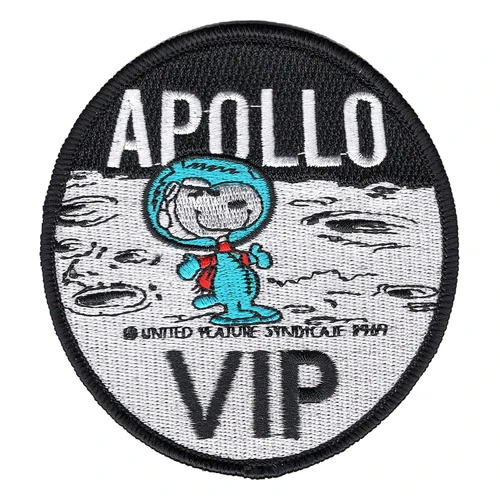
This patch is an oval, a little taller than it is wide, edged in a heavy black rolled border. APOLLO runs across the top in tall white letters on a black sky. Below it is the gray lunar surface, stitched with black-ringed craters, and the beagle stands in the middle in a turquoise suit and round helmet, red scarf trailing, giving a thumbs-up. A small line of black stitching under his feet carries a 1969 copyright date, the year of Apollo 10 and Apollo 11. Big black VIP letters fill the bottom of the oval.
For people who worked on Apollo, the beagle meant more than a cartoon. He stood for the idea that every weld, every checklist and every test sheet had a crew riding on it. Posters of him were seen at NASA facilities, and the silver beagle pin is still a high honor within NASA. The 1969 date on this patch puts it squarely in the year the program reached the Moon. It is a lighthearted design with a serious history behind it.
It looks right in a shadow box next to an Apollo 11 mission patch, or sewn on a denim jacket for a trip to the Kennedy Space Center or Space Center Houston. It is also a good gift for a grandchild who is just discovering the Moon landings, or for someone who spent a career in the space program. It measures 3.75 by 4 inches with an iron-on backing, and a few stitches around the edge will keep it on for good. A small patch with the whole Apollo era in it.
Related Products