
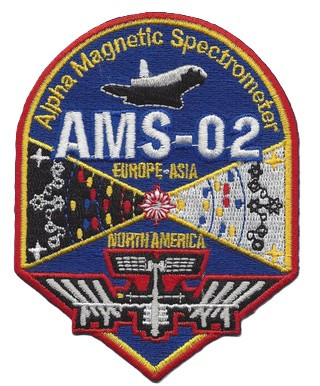
AMS-02 Alpha Magnetic Spectrometer Space Station Experiment Patch
- SKU:
- 9041
- MPN:
- 9041
- Width:
- 3.00 (in)
- Height:
- 4.00 (in)
- Depth:
- 0.08 (in)
- Backing:
- Iron On
- Edging:
- Cut Edge

Description
AMS-02 rode to orbit in the payload bay of Space Shuttle Endeavour on STS-134, Endeavour's final mission, and was installed on the International Space Station three days later. It is a particle physics detector, built to measure cosmic rays above the atmosphere and to search for antimatter and signs of dark matter. Nobel laureate Samuel Ting leads it. About 500 scientists from 56 institutions in 16 countries work on it under Department of Energy sponsorship. Its data goes down to an operations center at CERN in Geneva, which lists AMS among its recognized experiments as RE1.
The AMS-01 prototype went up first, aboard Discovery on STS-91 in June 1998. Once the space station's life was extended past 2015, the team replaced the planned superconducting magnet with the permanent magnet from AMS-01, giving up some field strength for an expected working life of 10 to 18 years instead of about three. Endeavour launched on May 16, 2011, and AMS-02 was berthed on the zenith side of the S3 truss on May 19. Between November 2019 and January 2020, ESA astronaut Luca Parmitano and NASA astronaut Andrew Morgan made four spacewalks to cut its old stainless steel cooling tubes and fit an upgraded cooling system, with Christina Koch and Jessica Meir running Canadarm2 from inside. A new silicon tracker layer, approved by DOE and NASA in 2023, is planned for launch in 2027.
The patch is a 3 by 4 inch shield, arched across the top and pointed at the bottom, with a red border and a cut edge that follows the outline. Alpha Magnetic Spectrometer arcs in yellow over a royal blue field, and a white shuttle orbiter flies above a bold white AMS-02. Across the middle, a black panel and a white panel scattered with colored dots and track-like marks meet at a red and white emblem, with EUROPE-ASIA stitched above it and NORTH AMERICA below. At the base, the station's truss and solar arrays stretch across a red band, the spot the detector has called home since 2011. It has an iron-on backing, and a few stitches around the border will keep it in place for good.
For anyone who worked the shuttle program, AMS-02 belongs to the last chapter. STS-134 was Endeavour's 25th and last flight and the next-to-last mission of the program. The detector it carried has kept working for well over a decade since, sending its data from the top of the station to physicists on the ground. When its cooling pumps wore out, the fix took four spacewalks and in-orbit cutting of stainless steel lines. That is a long working life for a payload that started as a prototype on a 1998 shuttle flight.
It fits a shadow box with an STS-134 or Endeavour patch, or the jacket of someone who worked the shuttle or space station programs. It is also a good gift for a physics student or a space fan who follows the station's science. One shield tells the whole story, from the shuttle bay to the S3 truss.
Related Products


