
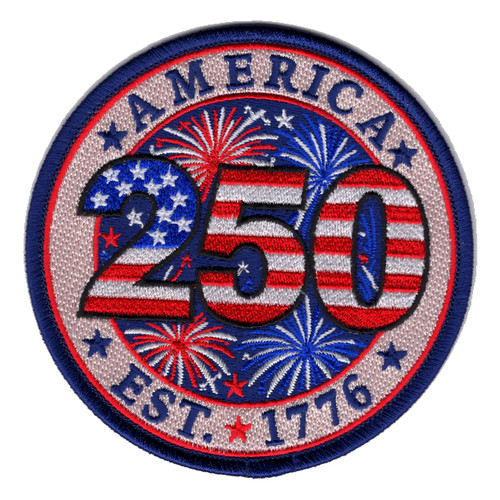
America 250th Anniversary Fireworks Est. 1776 Embroidered Patch
- SKU:
- 100466
- Width:
- 4.00 (in)
- Height:
- 4.00 (in)
- Depth:
- 0.02 (in)
- Backing:
- Iron On
- Edging:
- Merrowed Edge


Description
The first Fourth of July fireworks went up over Philadelphia in 1777, and the show on the Commons opened and closed with thirteen rockets, one for each state. A year earlier, on July 3, 1776, John Adams wrote to Abigail that the day ought to be marked with "Guns, Bells, Bonfires and Illuminations from one End of this Continent to the other." Philadelphia took him at his word on the first anniversary. This patch is built around those bursts. It reads AMERICA across the top and EST. 1776 across the bottom, with a flag-filled 250 through the middle.
Adams had the date off by two days. Congress voted for independence on July 2, 1776, the day he was writing about, and adopted the Declaration of Independence on July 4. At the 1777 celebration, armed ships and galleys on the Delaware River were dressed in colors and each fired a thirteen-gun salute, bells rang in the evening, and that night the rockets went up. For the Bicentennial on July 4, 1976, some fifty warships from more than twenty nations anchored in New York Harbor for the International Naval Review, and President Gerald Ford watched the tall ships of Operation Sail pass from the deck of USS Forrestal CV-59. The services got there first: the Army, the Navy and the Marine Corps were all founded in 1775, and each marked its own 250th in 2025. The naval review came back to New York Harbor for the 250th in July 2026, with the amphibious assault ship USS Kearsarge LHD-3 among the ships at anchor.
The patch is a 4-inch circle with a navy merrowed border and a thin red ring just inside it. A light gray band carries AMERICA in navy serif capitals across the top and EST. 1776 across the bottom, with a red star between EST. and the year and two navy stars on each side, one high and one low. Inside, a navy field holds red, white and blue starbursts, with small stars dropping between them like sparks on the way down. The 250 sits on top in heavy black-outlined numerals, and the flag runs through all three: the blue field and white stars fill the top of the 2, and the red and white stripes run through the base of the 2 and across the 5 and the 0. The stars land at the upper left of the number, right where the union sits on a flag hung flat on a wall.
The 250th belongs to every American, but it lands differently on anyone who has worn the uniform. In every one of those years somebody was on watch, on a flight line or in an engine room while everyone else looked up at the sky. Plenty of veterans stood a Fourth of July duty day far from home and heard about the fireworks secondhand. For a lot of them the Bicentennial is a real memory, whether they were aboard one of the ships in New York Harbor in 1976 or watching the parade of sail on a family television. This patch puts 1776, 1976 and 2026 in the same piece of thread.
Iron it or sew it onto the jacket or vest that comes out for the Fourth, the parade and the cookout. It also sits well in a shadow box beside a Bicentennial coin or pin from 1976, fifty years apart, or goes to a grandkid who watched the 2026 fireworks and wants something to keep from it. The backing is iron-on, and a few stitches around the merrowed edge make it permanent. There is another Fourth coming in July.
Related Products


