
Airborne Glider Operations Command Patch Airborne
- SKU:
- 4278
- MPN:
- 4278
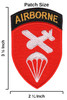
- Width:
- 2.25 (in)
- Height:
- 3.50 (in)
- Depth:
- 0.08 (in)
- Backing:
- Sew On
- Edging:
- Cut Edge
- Era:
- World War II


Description
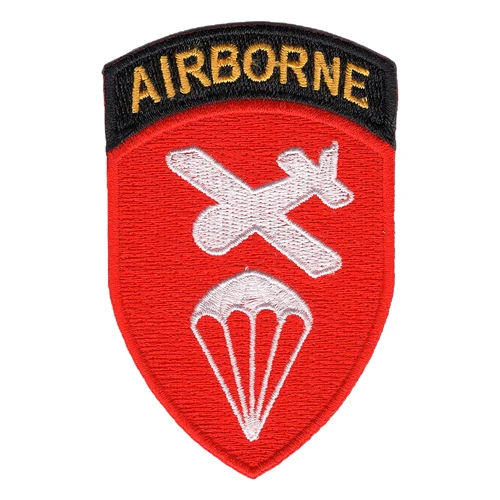
A white glider over a white parachute tells the whole story of how the U.S. Army put soldiers on the ground from the air in World War II. Paratroopers jumped in by static line, and glider infantry rode in aboard engineless aircraft cut loose from a tow plane. Both trades were organized and trained under Airborne Command, the headquarters stood up in 1942 to turn a handful of parachute units into whole airborne divisions. William C. Lee took command on 21 March 1942, was promoted to brigadier general that April, and drove the work on jump and glider facilities at Fort Benning, Fort Bragg and Pope Field. This patch carries the glider-and-parachute design tied to that command, under an Airborne tab.
Airborne Command took control of the U.S. Army Parachute School at Fort Benning, Georgia, along with the 501st, 502nd and 503rd Parachute Infantry Regiments and the 88th Infantry Airborne Battalion. It oversaw the activation of the 11th and 17th Airborne Divisions in 1943. Lee left in August 1942 as a major general to take the 101st Airborne Division, and Brigadier General Elbridge Chapman took over, followed by Brigadier General Leo Donovan in November 1943. In April 1943 the headquarters moved to Camp Mackall, North Carolina, where glider infantry regiments trained for landings by glider. In March 1944 the command was reorganized as the Airborne Center, with the 13th Airborne Division among its later charges.
The patch is a 2.25 by 3.5 inch shield with a pointed base, worked in bright red inside a narrow red border. A black tab arches across the top with AIRBORNE stitched in gold block letters. Below it a white glider crosses the field on a diagonal, high wing and slim fuselage, and under the glider hangs a white parachute canopy with its shroud lines gathered to a point. The two white shapes are the two ways into battle the command trained men for, one by tow rope and one by static line. The edge is cut close to the shield, and the back is made for sewing.
Airborne Command was a training and organizing headquarters, and its work shows in everything that followed. Every airborne soldier who passed through Benning, Bragg or Mackall in 1942 and 1943 came up through the system it built. The 11th and 17th Airborne Divisions were activated on its watch, along with the regiments and glider infantry that filled them. Camp Mackall, the command's home from 1943, is still in Army use for airborne and special operations training. For a family whose grandfather wore jump wings or the glider badge, this design is where that service started.
Sew it onto a vest for an airborne reunion, or mount it in a shadow box beside a set of jump wings or a glider badge. It also makes a fitting gift for a son or grandson piecing together where a World War II paratrooper or glider man trained. The backing is sew-on, so a few stitches around the cut edge hold it for good. It is a small piece of where American airborne warfare began.
Related Products


