
99th Infantry Division Checkerboard Patch
- SKU:
- 4737
- MPN:
- 4737
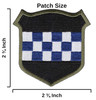
- Width:
- 2.75 (in)
- Height:
- 2.75 (in)
- Depth:
- 0.08 (in)
- Backing:
- Iron On
- Edging:
- Cut Edge


Description
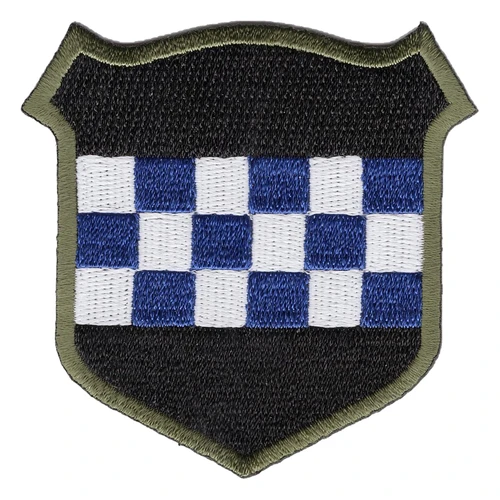
Count the squares on the 99th Infantry Division patch and you get nine white and nine blue, the division's number stitched into the checkerboard. The 99th was the Checkerboard Division, and the design goes back to 1923, when the division was headquartered in Pittsburgh. The blue and white come from the arms of William Pitt, the man the city was named for. The black field stands for iron from the Pittsburgh mills that turned out so many of its men. A 99th soldier could pick out that band of checks on a shoulder across a muddy road in the Ardennes.
The 99th Infantry Division was ordered into active service on 15 November 1942 at Camp Van Dorn, Mississippi, built around the 393rd, 394th and 395th Infantry Regiments. It reached England on 10 October 1944, moved to Le Havre in early November, and first went into the line on 9 November north of the Roer River. When the German offensive broke in December 1944, the division held the northern shoulder of the Battle of the Bulge and set up on Elsenborn Ridge alongside the 2nd Infantry Division. At Lanzerath, the Intelligence and Reconnaissance Platoon of the 394th under Lt. Lyle Bouck Jr. held up the 1st SS Panzer Division for nearly 20 hours. On 11 March 1945 the division crossed the Ludendorff Bridge at Remagen, and it finished the war with 151 days of combat across the Rhineland, Ardennes-Alsace and Central Europe campaigns.
This patch is the five-sided shield of the division, 2.75 by 2.75 inches. The cut edge follows the shield outline, finished with an olive drab border around the black field. Across the middle runs a three-row band of checks, white and blue alternating, nine of each. The black above and below gives the checks room to read from a distance, the same way they did on a wool uniform in 1944. It has an iron-on backing and can also be sewn on, the better choice for a jacket that will see the wash.
The 99th had never seen combat before that November, and by the end of the Bulge it had a name across the Army. Historian John S.D. Eisenhower called the stand of the 2nd and 99th Divisions the most decisive action of the Ardennes campaign. It came at a hard price, about a fifth of the division's effective strength, with 465 killed and 1,136 taken prisoner. Bouck's platoon at Lanzerath has been called the most decorated platoon for a single action of World War II. During the Bulge a United Press correspondent dubbed the men the Battle Babies, and the name stuck. The division came home in September 1945 and was inactivated on 15 October 1945 at Camp Patrick Henry, Virginia.
Mount it in a shadow box with a grandfather's Combat Infantryman Badge, his discharge papers and a photo from 1945, or put it on the jacket worn to a Bulge commemoration. It also makes a gift for the son or grandson who grew up hearing about Elsenborn Ridge. The checks still add up to 99.
Related Products


