
97th Signal Battalion Patch
- SKU:
- 10793
- MPN:
- 10793
- Width:
- 3.50 (in)
- Height:
- 3.50 (in)
- Depth:
- 0.08 (in)
- Backing:
- Iron On
- Edging:
- Cut Edge


Description
The 97th Signal Battalion was activated at Fort Sam Houston, Texas, on 10 April 1942, and by the winter of 1944 its Companies A and C were keeping XVIII Airborne Corps connected through the Battle of the Bulge. The battalion trained in Louisiana and Texas before sailing for Europe in October 1944. It landed in England and moved through France and Belgium to the front. From there it stayed in Germany for most of the next four decades. TRIED AND TRUE is a fair summary of that run.
After the Ardennes the 97th supported Ninth Army through the Roer and Rhine operations, and it backed XVI Corps in the Ruhr campaign that ended on 18 April 1945. After VE Day it moved to Augsburg and then to Lagarde Kaserne in Bamberg to support XV Corps, with Baker Company briefly at Pilsen, Czechoslovakia. On 1 May 1946 it became the 97th Constabulary Signal Squadron, at Patton Barracks in Heidelberg and then Panzer Kaserne in Boeblingen. It was redesignated the 97th Signal Operation Battalion in 1950 and assigned to Seventh Army, then the 97th Signal Battalion (Operation) on 15 February 1953. In the 1960s it served under the 7th Army Communications Command around Heidelberg, Boeblingen and Mannheim, and in July 1969 it was reassigned to CENTAG, working from Coleman Barracks in Sandhofen and the Feudenheim bunker.
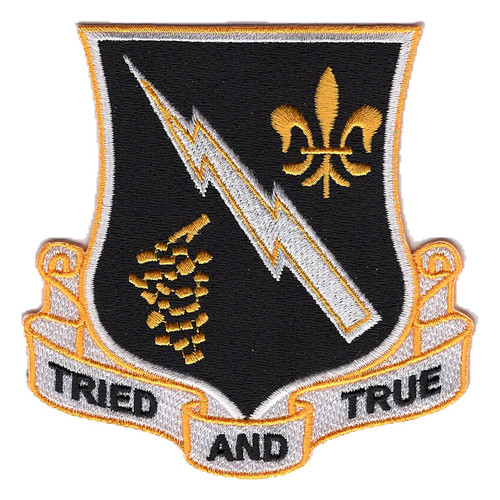
The patch is a black shield, 3.5 inches square overall, cut close to its outline with an orange and white border, the Signal Corps colors. A white lightning bolt trimmed in gold drives diagonally across the field from upper left to lower right. A gold fleur-de-lis sits in the upper right and a gold bunch of grapes in the lower left. The design was approved for the Constabulary squadron on 4 November 1949. TRIED AND TRUE runs in black letters across a white scroll trimmed in gold, wrapping around the base of the shield.
Signal soldiers rarely got the credit when the line held, only the blame when it failed. Through the Bulge, the Rhine crossings and the long Cold War watch in Germany, the 97th kept commanders talking to their units by wire, radio and message center. The work went on around the clock in VHF sites, bunkers and kasernes most Americans never heard of. Generations of signalmen rotated through Mannheim, Heidelberg and Boeblingen, each handing the network to the next. That is what TRIED AND TRUE meant in practice.
The iron-on backing presses onto a cotton or canvas jacket, and a few stitches around the edge will hold it through years of wear. It fits a shadow box with crossed flags, a set of orders and a photo from Coleman Barracks, or the vest worn to a Germany reunion. It also makes a good gift for a father or grandfather who strung wire for Seventh Army. The 97th Signal, black and gold, on one patch.
Related Products


