
82nd Airborne Division Patch

- SKU:
- 18
- MPN:
- 18
- Width:
- 2.00 (in)
- Height:
- 3.00 (in)
- Depth:
- 0.08 (in)
- Backing:
- Iron On
- Edging:
- Cut Edge



Description
The double A stands for All American, and it has meant that since 1917, when the division formed with soldiers drawn from every state in the Union. Sergeant Alvin York earned his Medal of Honor in the Argonne as an 82nd Division soldier in 1918. In August 1942 the division became the Army's first airborne division, and the AIRBORNE tab has ridden above the AA ever since. Its home is Fort Bragg, North Carolina, and its standing job is being ready to jump anywhere on earth on eighteen hours' notice. No shoulder patch in the Army is recognized faster, by soldiers or by the countries they dropped into.
The jumps are the resume: Sicily and Salerno in 1943, then Normandy, where the 505th Airborne Infantry Regiment dropped into Sainte-Mere-Eglise in the dark hours of D-Day. September 1944 brought Market Garden and the daylight crossing of the Waal at Nijmegen in canvas boats under fire. The 504th Airborne Infantry Regiment had already picked up the name Devils in Baggy Pants from a German officer's diary at Anzio. When the Bulge broke open in December 1944, the division rode trucks through the night into the line and held. The glidermen of the 325th Airborne Infantry Regiment went into Normandy and Holland without parachutes and with less glory, which the division has never forgotten. Since then the record added Grenada, a division combat jump into Panama in December 1989, the line in the sand of Desert Shield, and two decades of deployments to Iraq and Afghanistan.
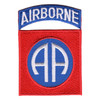
This is the classic two-piece look in one patch: the arched blue AIRBORNE tab in white letters joined above the red square, with the blue disc and white double A at center. The colors are the flag's on purpose, red, white, and blue, in a design a soldier can identify at a hundred meters. It measures 2 inches wide by 3 tall with the tab, cut edge, sized for a jacket shoulder the way it sat on a uniform. The backing is iron on, and it will take a needle if you would rather sew it.
The division's postwar title is America's Guard of Honor, and the culture underneath it is specific: somebody at Fort Bragg is always packed, weapons drawn, sitting on a ramp cycle, because the whole point of the 82nd is that it arrives first. Paratroopers of the 82nd hold their regiments close, 504, 505, 508, 325, and the AA on the shoulder is what they all share. The men of Sainte-Mere-Eglise and the men of the Panama night jump wore the same patch forty-five years apart. That continuity is the division's entire argument.
It mounts well in a shadow box under jump wings, next to a regimental crest and a static line's worth of memories. It also goes on a vest at an All American Week reunion, or to the paratrooper in the family who still counts his jumps out loud. Every trooper can tell you his regiment. This is the patch that held them all together.
Related Products


