8156 Marine Security Guard MSG MOS Patch

- SKU:
- 6441
- MPN:
- 6441
- Width:
- 4.50 (in)
- Height:
- 3.25 (in)
- Depth:
- 0.08 (in)
- Backing:
- Iron On
- Edging:
- Merrowed Edge


Description
The first two Marine Security Guard detachments left for Tangier and Bangkok on 28 January 1949, and Marines have stood post at American embassies every day since. MOS 8156 is the Marine on the other side of the hardline glass, the one visitors in more than 140 countries see before they ever see a diplomat. The program came out of the Foreign Service Act of 1946 and a December 1948 agreement between the State Department and the Marine Corps. The mission it set has not needed rewording since: protect the people inside the mission and the classified material they work with. This patch is the MOS plate for the Marines who drew that duty.
Every MSG is screened and trained by the Marine Corps Embassy Security Group at Quantico before a detachment ever gets him. The duty itself is Post One in Dress Blues, access control at the hardline, and destruction of classified material if the worst day arrives. The 81 occupational field also holds 8152 Security Forces, the Marines guarding naval installations and strategic weapons sites, but 8156 is the half of the field that serves under an ambassador. The worst days are on the record: on 30 April 1975, Master Sergeant Juan Valdez and ten other MSGs were the last Americans flown off the embassy roof in Saigon, and four years later the Tehran detachment went into captivity with the rest of the staff for 444 days. On 18 April 1983, Corporal Robert McMaugh was standing guard at Embassy Beirut when the truck bomb came. Twenty-four months on post earns the Marine Corps Security Guard Ribbon.
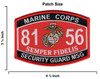
The plate uses the format Marines read at a glance: an arched rectangle with a red merrowed border, MARINE CORPS across the black band up top and SECURITY GUARD MSG across the band below. The red field carries 81 and 56 split around a gold and silver Eagle, Globe, and Anchor, with SEMPER FIDELIS beneath in white. Nothing on it is hidden code; the MOS number split around the emblem is the format's whole signature, and any Marine reads those four digits as a line from a service record. It measures 4.5 inches wide by 3.25 inches tall. The backing is iron on, and it will take a needle if you would rather sew it.
MSG duty is one of the few places the Corps hands a young NCO a clearance, a post on the far side of the world, and no battalion behind him. A detachment might be six Marines in a country where they are the only American military presence, which is why the screening runs harder than most special duty assignments. State Department officers build careers moving post to post; the Marines at Post One are the constant those posts share. Embassy duty has cost the program Marines from Beirut to Nairobi, and the detachments went back on post anyway, which is the entire point of the motto stitched under the emblem. Anyone who wore this plate remembers his tours by city name, not by unit number.
It mounts well in a shadow box beside the Marine Corps Security Guard Ribbon and a plate from each post city. It also carries fine on a vest at a detachment reunion, or as a gift for the Marine in the family who spent two years answering the bell at Post One. The duty was quiet when it went right. The patch says he did it anyway.
Related Products