
509th Airborne Infantry Regiment Patch
- SKU:
- 5070
- MPN:
- 5070
- Width:
- 3.00 (in)
- Height:
- 3.75 (in)
- Depth:
- 0.08 (in)
- Backing:
- Iron On
- Edging:
- Cut Edge


Description
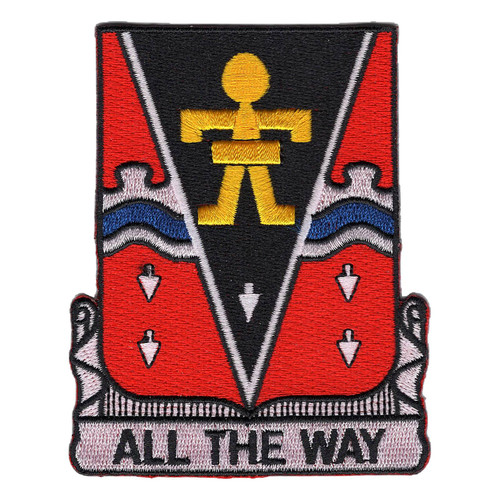
The five white arrowheads stitched on this shield count the five assault landings the 509th made in World War II. The unit began in 1941 as the 504th Parachute Infantry Battalion, was reflagged the 2nd Battalion, 503rd Parachute Infantry, and became the 509th Parachute Infantry Battalion in December 1943. On 8 November 1942 its paratroopers flew from England to North Africa for Operation Torch, the first American combat jump of the war. They have answered to Geronimo ever since. Today the 1st Battalion is the opposing force at the Joint Readiness Training Center at Fort Polk, Louisiana, and the 3rd Battalion jumps out of Joint Base Elmendorf-Richardson, Alaska.
The Torch flight was only the opening. On 15 November 1942 the battalion jumped onto the airfield at Youks-les-Bains, and on 14 September 1943 it dropped on Avellino behind the Salerno beachhead during Operation Avalanche. The 509th came ashore at Anzio on 22 January 1944, where Corporal Paul B. Huff earned the first Medal of Honor awarded to an American paratrooper. In August 1944 it jumped into southern France in Operation Dragoon, then fought through the Battle of the Bulge in Belgium, finishing near St. Vith in January 1945. In the modern era the 3rd Battalion deployed to Iraq in 2006 and 2007 and to Afghanistan in 2009 and again from late 2011, and it now serves in the 2nd Infantry Brigade Combat Team (Airborne), 11th Airborne Division.
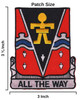
The patch is a 3 by 3.75 inch shield with a cut edge trimmed close to the outline of the shield and its scroll. A black pile edged in white drives down through a red field, and the black is a parachute jump in heraldic form. The gold figure inside it is the one the troopers knew as the Little Man in the Door, worn by the battalion in the Mediterranean Theater. The red is for the red berets of the British 1st Airborne Division, the paratroopers the 509th stood beside in England and North Africa. A wavy band of white and blue crosses the shield in two segments for the battalion's Presidential Unit Citation streamers, and as a water symbol it marks the landing at Anzio. ALL THE WAY runs in black letters across the silver scroll at the base.
As a separate battalion, the 509th fought across North Africa, Italy, France and Belgium, five assault landings in all. It was disbanded on 1 March 1945 and its troopers went to other airborne units, but the lineage came back. For decades the Geronimos at the Joint Readiness Training Center have hit rotational units hard so that their first real fight is not their first hard one. In Alaska the 3rd Battalion carries the same scroll into Arctic airborne work with the 11th Airborne Division. Every one of those troopers knows what the five arrowheads stand for.
Frame it in a shadow box beside a set of jump wings, or sew it onto the jacket that goes to the Geronimo reunion. It is also a good gift for the trooper who spent a rotation as OPFOR in the Louisiana pines. The backing is iron-on, and it takes a needle just as well if you would rather sew it. All the way, as the scroll says.
Related Products


