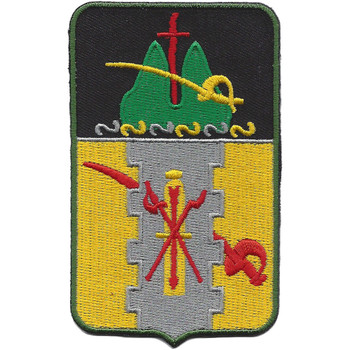
4th Cavalry Regiment Original Version Patch

- SKU:
- 9395
- MPN:
- 9395
- Width:
- 2.75 (in)
- Height:
- 4.00 (in)
- Depth:
- 0.08 (in)
- Backing:
- Iron On
- Edging:
- Cut Edge


Description
Every device on this shield points down, and each one stands for a chapter of 4th Cavalry history. The gold cannon in the center is reversed for the capture of Hood's artillery. The red saber laid across it is reversed for the rout of the Confederate cavalry at Murfreesboro. The bayonet beside it, together with the notched blue band behind them, is for the attack on the entrenchments at Selma, and the arrow running down the middle is reversed for the Indian Wars. The gold field is cavalry yellow, and the regiment has carried these colors and devices since the War Department approved them in 1922.
The regiment was organized at Jefferson Barracks, Missouri, on 26 March 1855 as the 1st Cavalry, with Colonel Edwin V. Sumner in command and Joseph E. Johnston as his lieutenant colonel, and it was Robert E. Lee's last command before the Civil War. On 3 August 1861 it was redesignated the 4th U.S. Cavalry. Its troopers fought at Shiloh, Stones River, Chickamauga, Nashville and Selma, then rode under Ranald S. Mackenzie against the Comanche and Kiowa from Blanco Canyon in 1871 to Palo Duro Canyon on 28 September 1874. In the Philippines the regiment fought the Moros at Bud Dajo in March 1906. On 6 June 1944 its men went ashore on the Saint-Marcouf Islands off Utah Beach, and the 4th Cavalry scouted for VII Corps through Cherbourg, the Hurtgen Forest and the Battle of the Bulge. In Vietnam the 1st Squadron, the Quarterhorse, rode with the 1st Infantry Division, and the 3rd Squadron helped defend Tan Son Nhut with the 25th Infantry Division during Tet in 1968.
The patch is a shield 2.75 inches wide and 4 inches tall, cut edge along the outline with a thin gold border. Down the center runs the blue pale, its sides notched like the top of a fortress wall. The gold cannon stands upright in it with the muzzle down, and the saber, bayonet and arrow cross over it in red. A second red saber runs straight through the blue band, the blade tip showing on the left and the hilt on the right. There is no motto scroll and no lettering, only gold, blue and red, which is all a cavalryman needs to read it. The back is iron-on.
The 4th Cavalry has been in the fight since 1855, from Mackenzie's troopers on the Texas plains to armored reconnaissance squadrons today. In February 1991 the 1st Squadron led the 1st Infantry Division's breach in Desert Storm and captured Safwan airfield. In Iraq the Quarterhorse fought at Samarra, and its Troop F fought in the Second Battle of Fallujah, and the 3rd Squadron served at Tal Afar and Balad. The 3rd and 6th Squadrons also deployed to Afghanistan, in Kandahar, Nangarhar and Kunar. A trooper from any of those squadrons served under the same shield Sumner's and Mackenzie's men did.
It fits a cavalry jacket or a riding vest, and it sits well in a shadow box beside a set of spurs and the crossed-sabers brass from a 4th Cavalry tour. It is also a good gift for a son or grandson who wants to know what the yellow and the sabers meant. One shield, a regiment's history stitched on it.
Related Products