
363rd Fighter Squadron WWII Patch
- SKU:
- 8931
- MPN:
- 8931
- Width:
- 4.00 (in)
- Height:
- 4.00 (in)
- Depth:
- 0.08 (in)
- Backing:
- Sew On
- Edging:
- Merrowed Edge
- Era:
- World War II


Description
On 12 October 1944 a 363rd Fighter Squadron P-51 pilot named Chuck Yeager shot down five Messerschmitt Me 109s in a single mission and became an ace in one day. He was flying Glamorous Glenn II out of RAF Leiston in Suffolk, and he finished the war credited with 11.5 enemy aircraft destroyed. Three years later he broke the sound barrier, but the flying that made him came with this squadron. The 363rd was one of three fighter squadrons in the 357th Fighter Group. The group flew the North American P-51 Mustang over Europe from early 1944 to the end of the war.
The 357th was the first P-51 group in the Eighth Air Force, training on Mustangs at Raydon in England from November 1943 before moving to Leiston, USAAF Station 373, near Theberton. The 363rd shared the field with the 362nd and 364th Fighter Squadrons. Its Mustangs carried the B6 code on the fuselage, and Yeager's P-51B Glamourus Glen was B6 Y. The squadron flew bomber escort deep into Germany, including Berlin missions in March 1944, and lost pilots and aircraft doing it. On 22 March 1944 the 363rd Mustang Old Crow failed to return from a Berlin escort, and Lt Carter Jones became a prisoner of war.
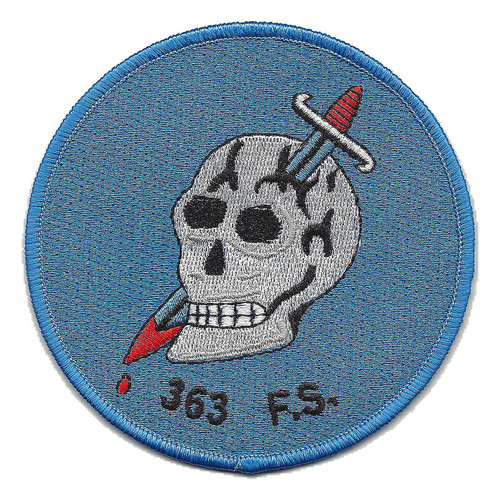
The patch is round, light blue, with a blue merrowed edge rolled around the rim. A gray and white skull sits in the center with a dagger driven down through it, white crossguard and red grip above, the bloody blade tip coming out below the jaw. A single red drop falls toward the lettering. Across the bottom, 363 F.S. is stitched in black in a loose, hand-painted style. It looks like something drawn on the back of a leather A-2 jacket in a Nissen hut, and that is the spirit of it.
Fighter pilots of the Eighth Air Force flew long escort missions over occupied Europe in single-seat airplanes, with the bombers counting on them to get there and back. The 357th Fighter Group came out of the war as one of the top-scoring fighter groups in the Eighth. The 363rd's men included pilots who went on to fly in later wars and test new airplanes, and many who did not come home from Europe. Ground crews at Leiston kept the Mustangs in the air through an English winter. This squadron is part of the reason the Luftwaffe lost control of the sky over Germany.
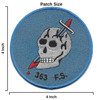
This patch measures 4 by 4 inches with a merrowed edge and a sew-on backing, sized for the back or shoulder of a flight jacket. It also fits a shadow box with Eighth Air Force patches, P-51 photographs or a relative's wartime medals. It is a good gift for a warbird fan or the family of a man who flew or wrenched with the 357th. The skull still looks right on a leather jacket.
Related Products


