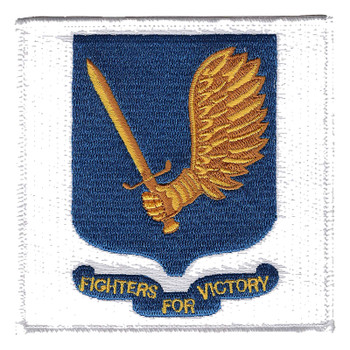
339th Fighter Group Patch
- SKU:
- 11405
- MPN:
- 11405
- Width:
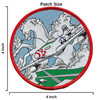
- 4.00 (in)
- Height:
- 4.00 (in)
- Depth:
- 0.08 (in)
- Backing:
- Iron On
- Edging:
- Merrowed Edge


Description
On 16 April 1945 the 339th Fighter Group claimed 118 enemy aircraft destroyed on the ground, eleven days after claiming 105 on 4 April, the only group to pass one hundred strafing victories twice. Those two days came at the end of a single year of combat out of RAF Fowlmere in Cambridgeshire. The group flew its first mission on 30 April 1944 and closed the war with the highest combined air and ground claims of any group in a single year. It flew P-51 Mustangs under the 66th Fighter Wing of VIII Fighter Command. For the pilots and ground crews of the 503rd, 504th and 505th Fighter Squadrons, that is the record this patch carries.
The 339th began on 3 August 1942 at Hunter Field, Georgia, as the 339th Bombardment Group (Dive), training on A-24 Banshee and A-25 Shrike dive bombers. It moved through Drew Field, Florida, Walterboro Army Airfield in South Carolina and Rice Army Airfield in the California desert, flying the Bell P-39 Airacobra, before shipping to England in April 1944. Redesignated the 339th Fighter Group in May, it went to war in the P-51. On 10 September 1944 the group escorted bombers into Germany and hit an aerodrome near Erding, and the next day it fought off attackers going after a bomber formation bound for Munich before strafing an airfield near Karlsruhe. Those two days earned the group the Distinguished Unit Citation. The 505th Fighter Squadron flew under the code 6N, the 503rd under D7 and the 504th under 5Q.
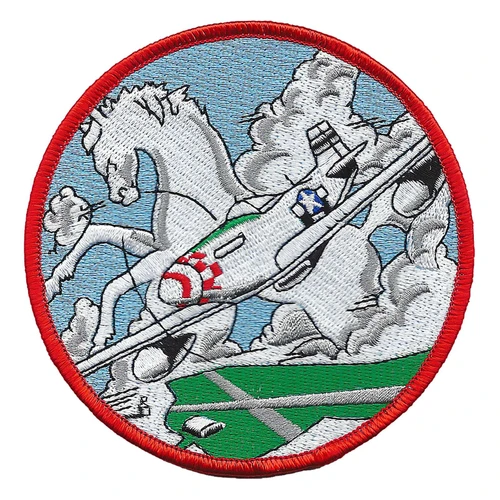
The patch is a 4 inch circle with a red merrowed edge. Inside, a rearing white horse with a wild mane charges out of a pale blue sky and towering white and gray clouds. A silver P-51 dives across the face in front of it, with a red and white checkered nose, a green stripe along the canopy and a blue and white national star on the fuselage. Below, a green field crossed by gray runways waits at the bottom of the dive. The red and white checks on the nose are the 339th's own mark: its Mustangs carried a nose band of red and white checks and a red and white spinner.
The group's war ran just over a year, from that first mission at the end of April 1944 to VE Day, and in that time it built a strafing record few groups came close to. Going down on an enemy airfield at low level, through flak, was some of the most dangerous work a fighter pilot did, and the 339th did it again and again. The ground crews at Fowlmere kept the Mustangs flying through an English winter to make it possible. The group came home to Camp Kilmer, New Jersey, and was inactivated on 18 October 1945. Its lineage carried on in the New York National Guard as the 107th Fighter Group.
The iron-on backing presses onto a jacket or a canvas bag, and a few stitches around the merrowed edge will hold it for good. It fits a shadow box next to a father's or grandfather's wings, a photo of a checker-nosed Mustang and an 8th Air Force patch, or a vest worn to an air show. It also makes a fine gift for a family member keeping a Fowlmere story alive. One year of combat, and a record that still stands out.
Related Products