28th Infantry Division Keystone Patch
- SKU:
- 14136
- MPN:
- 14136
- Width:
- 3.25 (in)
- Height:
- 3.50 (in)
- Depth:
- 0.08 (in)
- Backing:
- Iron On
- Edging:
- Cut Edge



Description
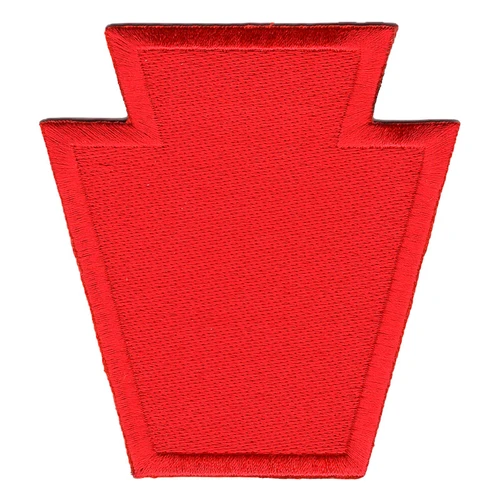
German soldiers named the 28th Infantry Division the "Bloody Bucket" because of this patch, a solid red keystone shaped like a pail. The keystone is the symbol of Pennsylvania, and the 28th is Pennsylvania's division, part of the Army National Guard. Its lineage as a division begins on 12 March 1879, when Governor Henry Hoyt appointed Maj. Gen. John F. Hartranft to command the Pennsylvania National Guard's new division. No other state had organized its Guard at that level in peacetime. That date makes the 28th the oldest division-sized unit in the Army, and its headquarters has been in Harrisburg since 1933.
In World War I the division fought through the Champagne-Marne, Aisne-Marne, Oise-Aisne and Meuse-Argonne campaigns, including the fight for Fismes and Fismette. After Chateau-Thierry, General John J. Pershing called it his "Iron Division." The keystone patch was approved in October 1918, in the last weeks of that war. In World War II the 28th landed in Normandy on 22 July 1944, went into Operation Cobra, and on 29 August 1944 marched down the Champs-Elysees during the liberation of Paris, then fought in the Hurtgen Forest that fall and fought in place on its Ardennes front when the German offensive hit in December. In January and February 1945 it attacked through the Kaysersberg Valley to help clear the Colmar Pocket.
The patch is one shape in one color, and it needs nothing else. It has a cut edge, trimmed close to the keystone's outline, so the silhouette is the design: a narrow top step, two square shoulders, and sides that taper toward the base. A raised red border runs just inside the outline and frames a flat field of red fill stitching. There is no lettering, no number and no motto on it. Anyone who served under it knows it on sight.
The 28th paid for its record in the fall and winter of 1944, when the Hurtgen and the Ardennes cost the division heavily. It came back, reorganized at Neufchateau, and was in the line again within weeks. The modern division has carried the same keystone overseas. In 2002 its headquarters took command of Task Force Eagle, the Northern Brigade of NATO's SFOR 12 mission in Bosnia, and in 2003 it led KFOR 5A in Kosovo, the first reserve component division headquarters to do so. The 2nd Brigade Combat Team deployed to Ramadi in Al Anbar Province in 2005, and the 56th Stryker Brigade served in Iraq in 2008 and 2009.
It fits in a shadow box beside a grandfather's World War II medals, or on the vest worn to a 28th Division reunion. It is also a good gift for a son or daughter now serving in the Pennsylvania Guard, so the patch on their shoulder has some company at home. The iron-on backing goes on with a household iron, and it can also be sewn on for a permanent hold. It is a plain red keystone, and that has always been enough.
Related Products