25th Infantry Division Military Occupational Specialty MOS Patch Tropic Lightning
- SKU:
- 5252
- MPN:
- 5252
- Width:
- 4.50 (in)
- Height:
- 3.25 (in)
- Depth:
- 0.08 (in)
- Backing:
- Iron On
- Edging:
- Merrowed Edge


Description
The red taro leaf on the 25th Infantry Division's patch is there because the division was born in Hawaii, carved out of the old Hawaiian Division at Schofield Barracks on 1 October 1941. The yellow lightning flash across it stands for the way the division carries out its assignments. Soldiers have called it the Electric Strawberry for generations. The nickname Tropic Lightning came from how fast the division moved through its Pacific campaigns. This MOS-style patch puts that leaf front and center between a bold 25TH and ID.
The division was built from the 27th and 35th Infantry Regiments of the Hawaiian Division plus the 298th Infantry of the Hawaii National Guard. Its first elements landed near the Tenaru River on Guadalcanal on 17 December 1942, and it fought on through New Georgia and Vella Lavella before landing at San Fabian on Luzon on 11 January 1945. In July 1950 it went to Korea under Major General William B. Kean, held the approaches to Pusan, and later guarded the approaches to Seoul in 1953. In Vietnam the division headquarters sat at Cu Chi from January 1966 to February 1970, through Operations Attleboro, Cedar Falls and Junction City and the fighting around Saigon during Tet. Brigades from Schofield went to Iraq and Afghanistan beginning in 2004.
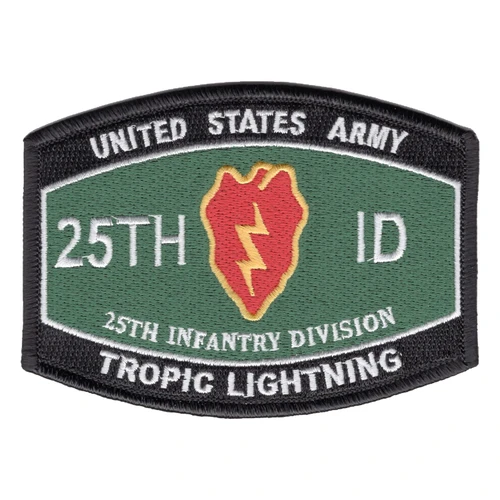
This patch measures 4.5 inches wide by 3.25 inches tall and follows the familiar rating-patch outline, with arched bands top and bottom and a black merrowed edge. UNITED STATES ARMY runs across the top band in white, and TROPIC LIGHTNING fills the bottom band. The green center panel carries 25TH on the left and ID on the right, with the red taro leaf, gold border and yellow flash between them. Under the leaf, 25TH INFANTRY DIVISION is stitched in a soft green-gray. The back is iron-on, and it can be sewn on as well.
Few divisions can say they fought in World War II, Korea and Vietnam and still call the same post home. Twenty-two Tropic Lightning soldiers received the Medal of Honor in Vietnam, and fourteen in Korea. Wolfhounds of the 27th Infantry, Gimlets of the 21st and the men of the 35th and 14th all wore this same leaf. For many soldiers Schofield Barracks was their first look at Hawaii, and Cu Chi was their first look at war. The patch on this rocker ties both together.
It sits well in a shadow box with a Vietnam Service Medal and a photo from Cu Chi, or on a vest worn to a 25th Infantry Division Association reunion. It also makes a good gift for a son or grandson who wants to know what his grandfather's leaf meant. Press it on or stitch it down, and the leaf goes with him. Hawaii to Guadalcanal to Cu Chi, one red leaf.
Related Products