
1st Air Cavalry Airmobile Patch
- SKU:
- 10226
- MPN:
- 10226
- Width:
- 4.00 (in)
- Height:
- 4.00 (in)
- Depth:
- 0.08 (in)
- Backing:
- Iron On
- Edging:
- Merrowed Edge


Description
In 1965 the 11th Air Assault Division (Test) at Fort Benning was reflagged as the 1st Cavalry Division (Airmobile), and the Army had its first airmobile division. Within about 90 days the First Team was in combat in Vietnam, the first division fully committed to the war. The yellow cavalry shield stayed. The horses were now helicopters. Air Cav meant a rifle company could be carried over jungle and ridgeline and set down where the enemy did not expect it. This patch puts that whole idea in one picture: the horse head shield, a helicopter, and troopers moving out under the rotor.
The Pleiku campaign opened on 29 October 1965, 35 days of airmobile operations that earned the division the first Presidential Unit Citation given to a division in Vietnam. Inside it came the Ia Drang, 14 to 18 November 1965, when Lt. Col. Hal Moore's 1st Battalion, 7th Cavalry went into LZ X-Ray aboard UH-1 Hueys and fought the first major battle between the U.S. Army and the North Vietnamese Army. On 17 November the 2nd Battalion, 7th Cavalry was ambushed near LZ Albany. Huey pilots Bruce Crandall and Ed Freeman flew unarmed into X-Ray again and again with water and ammunition, and both later received the Medal of Honor. Operation Pershing ran until January 1968, the division fought through Tet at Quang Tri and Hue and then moved to relieve the Marines at Khe Sanh, and in May 1970 it was first into Cambodia.
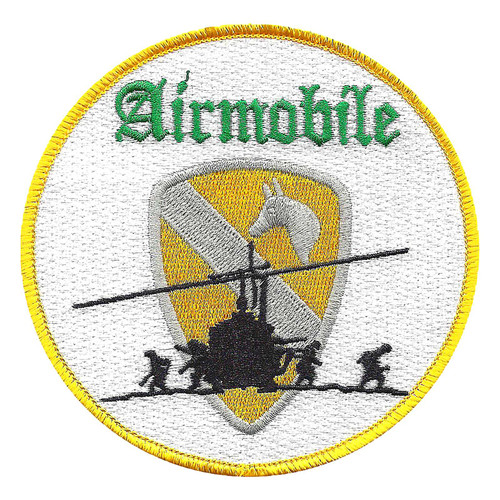
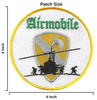
The patch is a 4 inch circle with a gold merrowed edge around a white field. Across the top, Airmobile is stitched in green Old English lettering. Below it sits the cavalry shield in yellow, with the diagonal stripe and horse head done in silver-gray instead of the usual black. Over the shield, a two-bladed helicopter in black silhouette sits on the skyline while four troopers run out from under the rotor, the moment every air assault came down to. It reads as clearly from across a room as it does in your hand.
Air Cav changed how the Army fought in Vietnam. The helicopter put a battalion on a landing zone in minutes, and it pulled the wounded out the same way. The troopers who rode the slicks and the crews who flew them earned a reputation for going in fast and staying in the fight. Most of the division came home in 1971, and its last brigade began leaving Vietnam in 1972. The men who wore the big yellow patch in those years still call it the First Team.
Sew it on the vest you wear to a 1st Cavalry Division reunion, or set it in a shadow box beside a Combat Infantryman Badge and a photo from Vietnam. It also makes a good gift for a son or grandson who grew up hearing about the Air Cav. The iron-on backing goes onto a jacket in a few minutes, and it can be sewn on for good.
Related Products


