160th SOAR Night Stalker Medicine Special Operations Flight Medics Patch
- SKU:
- 10
- MPN:
- 10
- Width:
- 4.00 (in)
- Height:
- 4.00 (in)
- Depth:
- 0.08 (in)
- Backing:
- Iron On
- Edging:
- Merrowed Edge


Description
The wings on this patch carry TF. 160, the name the Night Stalkers flew under before the Army made them the 160th Aviation Battalion on 16 October 1981. Task Force 160 came together after Operation Eagle Claw, the failed attempt to rescue the hostages in Tehran in April 1980. Army aviators from the 101st Aviation Group were pulled into a provisional task force and trained to fly special operations missions at night. That task force became the regiment. This design is for the medics who ride in its aircraft, with NIGHT STALKER MEDICINE across the top.
The battalion became the 160th Aviation Group (Airborne) in 1986 and the 160th Special Operations Aviation Regiment (Airborne) in May 1990, with its headquarters at Fort Campbell, Kentucky. It flies the AH-6 and MH-6 Little Bird, the MH-60 Black Hawk, including the Direct Action Penetrator gunship, and the MH-47 Chinook. Its first combat was Operation Urgent Fury in Grenada in 1983, followed by Operation Just Cause in Panama in 1989 and Operation Desert Storm in 1991. In October 1993 two of its Black Hawks went down in Mogadishu during Operation Gothic Serpent. In October 2001 its crews inserted Special Forces teams into Afghanistan, and in May 2011 they flew the Operation Neptune Spear raid in Pakistan.
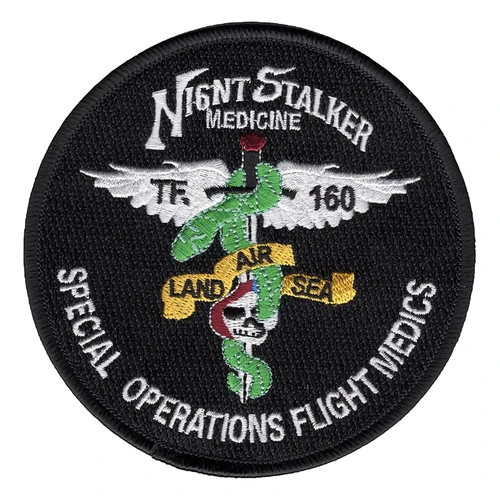
The patch is a round 4 inches across, black twill with a black merrowed edge. NIGHT STALKER MEDICINE arches across the top in white, and SPECIAL OPERATIONS FLIGHT MEDICS curves around the bottom. In the center a sword stands point down through a pair of white wings marked TF. 160, with a maroon pommel at the top. A green serpent winds down the blade, the old sign of medicine wrapped around a weapon, and a gold scroll reading LAND AIR SEA crosses it above a white skull. The backing is iron-on, and it sews on cleanly.
A flight medic in this regiment treats wounded men in the back of a helicopter, at night, often under fire, on aircraft that fly lower and closer than anyone else's. Five Night Stalkers were among the 18 Americans killed in Mogadishu, and the regiment has carried its losses on every deployment since. Its medics can qualify as Special Operations Combat Medics through the course at Fort Bragg. The motto the whole regiment answers to is Night Stalkers Don't Quit.
Put it in a shadow box with a maroon beret flash and your 160th patches, or on the vest you wear to a regimental reunion. It also makes a good gift for a medic heading to Fort Campbell, or a veteran who wore the TF 160 name before the regiment existed. Land, air or sea, the medic goes along.
Related Products