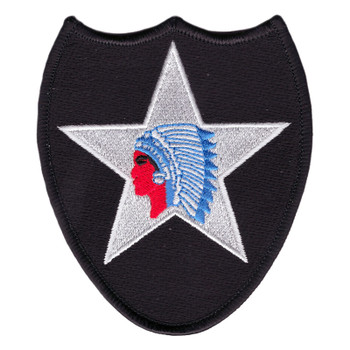
104th Infantry Division Patch

- SKU:
- 4684
- MPN:
- 4684
- Width:
- 2.62 (in)
- Height:
- 2.62 (in)
- Depth:
- 0.08 (in)
- Backing:
- Sew On
- Edging:
- Merrowed Edge
- Era:
- World War II


Description
The Timberwolves did their hardest fighting in the dark, and the 104th Infantry Division's night attacks along the Roer in December 1944 gave German defenders no rest. That habit came from the top. Major General Terry de la Mesa Allen took the division in October 1943 and kept it until after the war ended. Under him the 104th logged 200 days of combat between the Dutch border and the middle of Germany. It went in as a new division and came out with a reputation for fighting at night that other units noticed.
The 104th was activated on 15 September 1942, shipped overseas in late August 1944 and landed in France on 7 September. On 15 October it was attached to the British I Corps under the Canadian First Army, and on 26 October it attacked and took Zundert on the way to the Mark River. In November it moved to the Aachen front and fought house to house through the Eschweiler and Weisweiler industrial belt, with Weisweiler falling on 25 November. The division held the Roer line through the winter, entered Cologne on 5 March 1945 and crossed the Rhine at Honnef on 22 March to attack out of the Remagen bridgehead. It cleared the Mulde River sector by 21 April and met the Red Army at Pretzsch on 26 April.
The patch is a small circle, 2.62 inches across, in green with a dark green merrowed edge rolled all the way around. A gray timberwolf fills most of the field, head thrown back with the muzzle open in a howl. There is no lettering, and none is needed for anyone who served in the division or grew up hearing about it. The wolf is stitched in a single gray with darker gray line work for the eye, the ear and the fur at the throat. The back is sew-on, made to be stitched to a sleeve, a vest or a display board.
The Timberwolves are also on the record at Nordhausen. In April 1945 the 104th and the 3rd Armored Division came on the Dora-Mittelbau camp, and the US Holocaust Memorial Museum recognizes the 104th as a liberating unit. Men who walked into that camp carried what they saw for the rest of their lives. The division counted three campaigns, Northern France, Rhineland and Central Europe, and was inactivated on 20 December 1945. The howling wolf stayed with the families of the men who wore it.
It fits a shadow box beside a father's or grandfather's Combat Infantryman Badge and his discharge papers, or a vest worn to a reunion or a Veterans Day parade. It also makes a good gift for a grandson building a family history of the European war. Stitch it down once and it stays. One gray wolf, Holland to the Mulde.
Related Products