101st Airborne Division Screaming Eagles Embroidered Patch
- SKU:
- 5246
- MPN:
- 5246
- Width:
- 4.38 (in)
- Height:
- 3.25 (in)
- Depth:
- 0.08 (in)
- Backing:
- Sew On
- Edging:
- Merrowed Edge

Description
The 101st Airborne Division was activated on 16 August 1942 at Camp Claiborne, Louisiana, and its first commander, Maj. Gen. William C. Lee, told the new soldiers that the division had no history but had a rendezvous with destiny. That rendezvous came in the first hours of 6 June 1944, when 101st pathfinders led the way and the division parachuted into Normandy ahead of the D-Day beach landings. In September 1944 the Screaming Eagles jumped into Holland for Operation Market Garden, and that December they were rushed to Bastogne, Belgium, during the Battle of the Bulge.
Surrounded at Bastogne, acting division commander Brig. Gen. Anthony McAuliffe answered a German demand to surrender with one word: "Nuts!" The division held the town until the siege was lifted, and the entire division received the Distinguished Unit Citation for its stand at Bastogne. The Screaming Eagles ended the war in Europe at Berchtesgaden in the Bavarian Alps, where Hitler had his mountain retreat, and the division was inactivated on 30 November 1945.
Reactivated more than once after the war, the 101st moved to Fort Campbell, Kentucky, in 1956. It sent its 1st Brigade to Vietnam on 29 July 1965, and the rest of the division followed in November 1967. In 1968 the division took on the structure and equipment of an airmobile division, moving its soldiers into battle by helicopter. The 101st began withdrawing from Vietnam in 1971, and in 1974 it was redesignated the 101st Airborne Division (Air Assault), the name it carries today.
On 17 January 1991, AH-64 Apache helicopters of the 101st destroyed two Iraqi early warning radar sites in one of the opening strikes of Operation Desert Storm, and during the ground war in February the division carried its soldiers by helicopter as far as 155 miles behind Iraqi lines. In 2003 the Screaming Eagles fought in the invasion of Iraq, including at Karbala, before moving north to Mosul, and the division deployed repeatedly to Iraq and Afghanistan in the years that followed. The 101st carries on the traditions of the Wisconsin volunteer regiments of the Civil War, which is why the eagle on its shoulder insignia is Old Abe, the bald eagle that went to war with them.
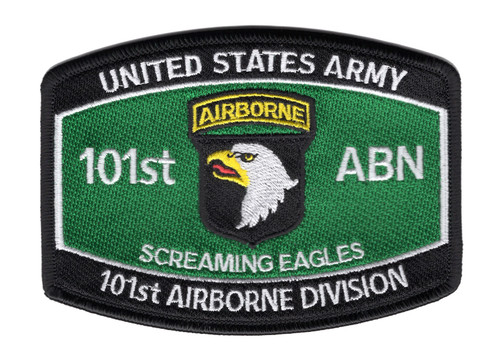
This patch is a horizontal design with arched top and bottom edges, measuring 4.38 inches wide by 3.25 inches tall, with a black merrowed edge. "UNITED STATES ARMY" runs across the black top band in white, and "101st AIRBORNE DIVISION" fills the black bottom band. The green center panel, outlined in white, carries "101st" on the left, "ABN" on the right, and the division shoulder insignia in the middle: a white eagle head with a gold beak and red tongue on a black shield, under a black Airborne tab with gold lettering. "SCREAMING EAGLES" is stitched in white below the shield. It has a sew-on backing for jackets, vests, caps, bags and shadow boxes.
Related Products