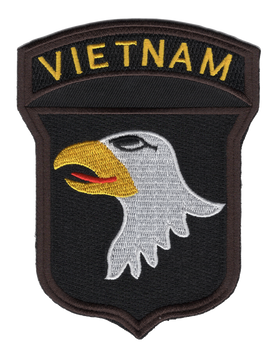
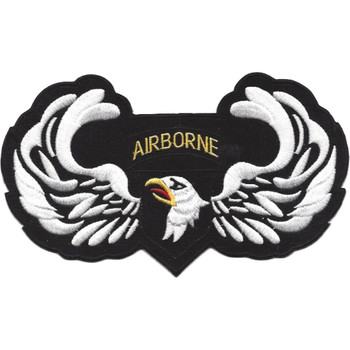
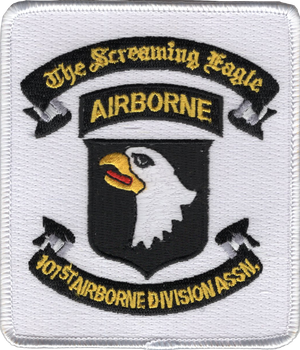
101st Airborne Division Screaming Eagles Embroidered Patch
- SKU:
- 5246
- MPN:
- 5246
- Width:
- 4.38 (in)
- Height:
- 3.25 (in)
- Depth:
- 0.08 (in)
- Backing:
- Sew On
- Edging:
- Merrowed Edge

Description
The 101st Airborne Division jumped into Normandy in darkness on June 6, 1944, dropped into Holland during Market Garden, and held the line at Bastogne with no winter gear and dwindling ammunition while surrounded by German armor. Activated at Camp Claiborne, Louisiana in August 1942, the division trained at Fort Benning and Camp Mackall before shipping to England in 1943. The Screaming Eagles became one of two American airborne divisions to fight across the European Theater, earning a Distinguished Unit Citation for Bastogne and another for Normandy. After World War II, the division deactivated briefly before returning to jump status during the Cold War, then deployed to Vietnam in 1965 where it transitioned from parachute operations to heliborne air assault, a mission it still carries today.
In Vietnam, the 101st operated in I Corps from 1968 forward, with the division conducting air mobile operations across the A Shau Valley, Hamburger Hill, and Fire Support Base Ripcord. The division returned to Fort Campbell, Kentucky in 1972 and reorganized as an air assault division, replacing parachutes with helicopters as the primary insertion method. During Operation Desert Storm in 1991, the 101st executed a 155-mile air assault deep into Iraq, the longest heliborne operation in history, cutting off Iraqi forces and supply lines. The division deployed to the Balkans in the 1990s, then went to Iraq in 2003 as part of the initial invasion. Between 2003 and 2014, the 101st became the most deployed division in the Army, with multiple brigade combat teams rotating through Iraq and Afghanistan on 12- and 15-month tours.
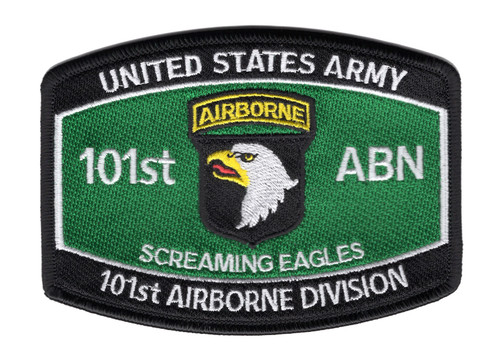
This patch uses a horizontal oval shape with a black merrowed border and black top arch. White chain-stitched lettering across the top reads "UNITED STATES ARMY" while the bottom black field carries "101st AIRBORNE DIVISION" in white. The green center field is split by a white border line, with "101st" on the left, "ABN" on the right, and the Screaming Eagle insignia centered: a white eagle head on a black shield with the yellow "AIRBORNE" tab above it. Below the eagle, "SCREAMING EAGLES" appears in white on green. The patch balances official military identification with the aggressive imagery that defined the division's reputation from its first combat drop to its final air assault missions in Afghanistan.
The 101st earned its nickname and reputation through sustained combat across multiple wars, not through peacetime training. Bastogne defined the division's culture: surrounded, outgunned, and asked to surrender, Brigadier General McAuliffe replied "Nuts" and the division held until Patton's armor broke the siege. That same refusal to yield carried through Vietnam's jungle fighting, Desert Storm's deep strikes, and the sustained counterinsurgency grind in Iraq and Afghanistan. The division took losses at Hamburger Hill, during the Mosul deployments, and in the Kunar and Paktika provinces, but the Screaming Eagle remained on line. The Air Assault Badge replaced jump wings for most soldiers, but the yellow Airborne tab stayed on the patch as a link to the paratroopers who went in first at Normandy.
The patch mounts in shadow boxes between CIBs, Air Assault wings, and deployment patches from Zabul Province or the Sunni Triangle. It works on the back of a motorcycle vest next to other Fort Campbell unit patches or on a garrison cap for someone who was there when the division still jumped. Some veterans frame it with a deployment coin and a photo of a Chinook on the tarmac at Bagram. Others give it to a son or daughter headed to basic, or to a grandchild who wants to know where grandpa was between 1968 and 1970. It is a piece of the unbroken line from Normandy to Kandahar, carried by soldiers who wore the Screaming Eagle in combat.
Related Products