100th Fighter Squadron Tuskegee Airmen Winged Panther Patch
- SKU:
- 322
- MPN:
- 322
- Width:
- 4.00 (in)
- Height:
- 4.00 (in)
- Depth:
- 0.08 (in)
- Backing:
- Iron On
- Edging:
- Merrowed Edge



Description
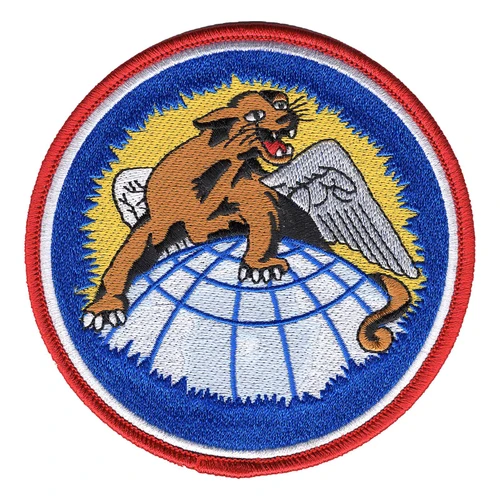
The winged panther crouched on a white globe here is the 100th Fighter Squadron's own emblem, approved on November 25, 1944, while the squadron was flying P-51 Mustangs out of Italy with the 332nd Fighter Group. The 100th was activated on February 19, 1942, at Tuskegee Army Air Field, Alabama, one of the squadrons of Black fighter pilots trained there. With the 301st and 302nd Fighter Squadrons it made up the 332nd, the group the world now knows as the Tuskegee Airmen. Segregation policy held them in training far longer than white units of the same era. When they finally deployed, they flew escort and combat missions across the Mediterranean and European theaters.
Over the course of the war the 100th flew the Curtiss P-40 Warhawk, the Bell P-39 Airacobra, the Republic P-47 Thunderbolt and finally the North American P-51 Mustang, the airplane the 332nd made famous with its red tails. The squadron was inactivated at Camp Kilmer, New Jersey, in October 1945, then reactivated at Lockbourne, Ohio, on July 1, 1947, where it served until it was inactivated on July 1, 1949, following Executive Order 9981, the 1948 order that ended segregation in the armed forces. On September 13, 2007, the 100th came back as an Alabama Air National Guard squadron, taking the place of the 160th Fighter Squadron. It flies with the 187th Fighter Wing at Dannelly Field in Montgomery, flying the F-16C/D Fighting Falcon until 2023. The first F-35A Lightning II jets arrived on December 6, 2023.
The patch is 4 inches round with a red merrowed edge, a thin white ring and an ultramarine blue field. A tan panther with black markings crouches on top of a white globe laced with blue grid lines, mouth open in a snarl, a pair of white wings rising off its back. A jagged yellow-orange burst glows behind it, and its tail curls down over the right side of the globe. The colors and layout follow the emblem as approved in 1944, red border and all. It has an iron-on backing and can be sewn on for a permanent hold.
The 100th belongs to the Tuskegee story, and that story did not end in 1945. The squadron whose deployment was once held back because of who its pilots were now carries their number at an Air National Guard base about forty miles from where it was born. Pilots of the 100th today fly a fifth-generation fighter under the same panther. The number connects the men who trained at Tuskegee Army Air Field to the Guardsmen in Montgomery. Few squadron numbers carry that much history.
Put it in a shadow box with a Tuskegee Airmen print or a P-51 model, or on the jacket you wear to an air show. It makes a good gift for an Alabama Guardsman, a pilot, or a student of the Tuskegee Airmen. At 4 inches it sits well beside other World War II fighter squadron patches. The winged panther, the globe and the red border of 1944.
Related Products