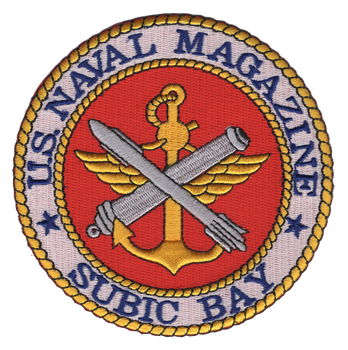
US Naval Base Subic Bay Patch

- SKU:
- 14182
- MPN:
- 14182
- Width:
- 4.00 (in)
- Height:
- 4.00 (in)
- Depth:
- 0.08 (in)
- Backing:
- Iron On
- Edging:
- Cut Edge




Description
For nearly a century, U.S. Naval Base Subic Bay stood as one of the most important forward naval installations in the Pacific. Carved into the natural deep-water harbor of Luzon in the Philippines, Subic Bay was not simply a port—it was a strategic hinge between oceans, wars, and eras. From its earliest days, the base reflected the reality that naval power is sustained not only by ships at sea, but by the infrastructure that keeps them moving.
Established in the early twentieth century and expanded significantly before World War II, Subic Bay became a cornerstone of American presence in the Western Pacific. Its location offered immediate access to the South China Sea and the broader Indo-Pacific, making it indispensable for fleet operations. When war came to the Pacific, the base was contested, damaged, and ultimately reclaimed, emerging from the conflict as a symbol of endurance and strategic necessity.
During the Cold War, Subic Bay reached its full significance. It became the largest overseas U.S. naval facility in the world, supporting aircraft carriers, submarines, destroyers, and logistics ships operating far from home ports. The base functioned as a complete naval ecosystem—repair yards, supply depots, airfields, hospitals, and housing—allowing the fleet to sustain long-term forward deployment without returning to the continental United States.
Vietnam defined Subic Bay’s operational tempo for an entire generation. Ships rotated continuously through the base for repair, resupply, and brief respite between combat deployments. For countless sailors, Subic was both a lifeline and a waypoint—a place where the strain of extended operations briefly eased before the next underway period began. Its docks and dry docks quietly supported one of the largest sustained naval efforts in American history.
Beyond war, Subic Bay also played a central role in deterrence and presence missions across Southeast Asia. Submarines slipped in and out of its waters, carrier strike groups staged operations, and humanitarian assistance flowed outward during regional crises. The base embodied the Navy’s ability to remain forward, flexible, and ready in a region where stability was never guaranteed.
In 1992, U.S. forces departed Subic Bay, closing a chapter shaped by geopolitics, alliance, and transition. The base’s closure marked the end of an era, but not the erasure of its legacy. For those who served there, Subic remains vivid in memory—defined by heat, steel, routine, and the understanding that they were standing watch far from home in service of something larger.
Today, U.S. Naval Base Subic Bay endures in history as a symbol of forward naval power and Pacific commitment, remembered through the ships it sustained and the sailors who passed through its gates.
Related Products