U.S. Naval Station Adak Alaska Birthplace of the Winds Embroidered Patch
- SKU:
- 1320
- MPN:
- 1320
- Width:
- 5.00 (in)
- Height:
- 4.38 (in)
- Depth:
- 0.08 (in)
- Backing:
- Iron On
- Edging:
- Merrowed Edge


Description
Naval Station Adak was the Navy's westernmost installation in the Pacific, sitting so far out the Aleutian Chain that it was geographically closer to Petropavlovsk-Kamchatsky than to Anchorage. The Aleuts called the island home for centuries before the Navy arrived in World War II, and the Japanese understood its strategic value well enough to contest it. By the Cold War, Adak had become one of the most important anti-submarine warfare platforms the Navy operated anywhere, a forward base from which P-3 Orion crews flew long patrols out over the North Pacific, watching for Soviet submarines running the deep water lanes below.
VP squadrons rotated through Adak on a steady basis throughout the Cold War decades, flying the P-3A, P-3B, and eventually the P-3C out of the base's runway into weather that made the Atlantic theater look comfortable. Williwaws -- sudden, violent gusts that roll down off volcanic terrain with almost no warning -- were a fact of life at Adak. The base motto, "Birthplace of the Winds," was not chosen for poetry. Patrol crews and the maintenance personnel who kept the Orions airworthy operated year-round in conditions that most naval air stations never encountered. The mission was tracking Soviet boat movements through the Aleutian passes, and it was taken seriously from the first deployment to the last.
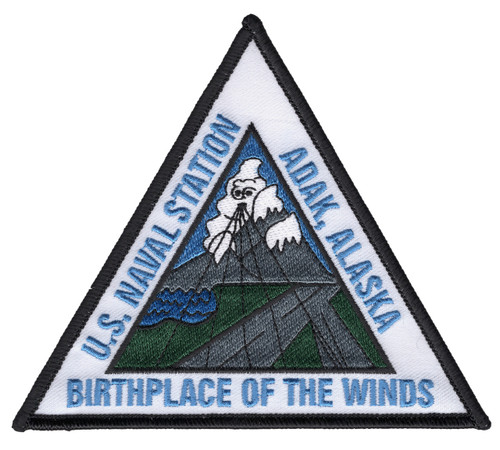
The patch is triangular, matching the volcanic geometry of the island itself, with a black merrowed border framing a white outer field that carries the full station name in blue block lettering -- "U.S. Naval Station" climbing the left side, "Adak, Alaska" descending the right, and "Birthplace of the Winds" running straight across the base. Inside the triangle, dark volcanic peaks rise against a blue-gray sky, and a stylized white wind figure emerges from the summit, arms wide, the kind of cartoon that only makes sense if you've actually stood on a flightline while a williwaw came through. The greens and grays of the terrain below are rendered in close, layered stitching that captures the bleak, specific color of Aleutian ground. At 5 inches wide by 4.38 inches tall, it displays with real presence.
BRAC 1997 shut Adak down, and the Navy walked away from infrastructure it had spent decades building. The Aleut Corporation acquired most of the island, and a small civilian community formed around what remained. For the sailors and aircrews who pulled deployments there during the Cold War years, the closure was another chapter in a story that the broader public never really followed. Adak never got the recognition that more visible Cold War postings did, partly because the mission was quiet by design and partly because the Aleutians are not a place that invites casual attention. The people who were there knew what they were doing and why it mattered.
The patch fits cleanly in a shadow box alongside VP squadron patches, Aleutian-tour memorabilia, or the other pieces of a career that took someone to the far edges of the Pacific. It works on a vest at a patrol aviation reunion, on a jacket, or as a direct and specific gift for anyone whose service record includes Adak. The island left a mark on everyone who spent time there. This patch carries it forward.
Related Products