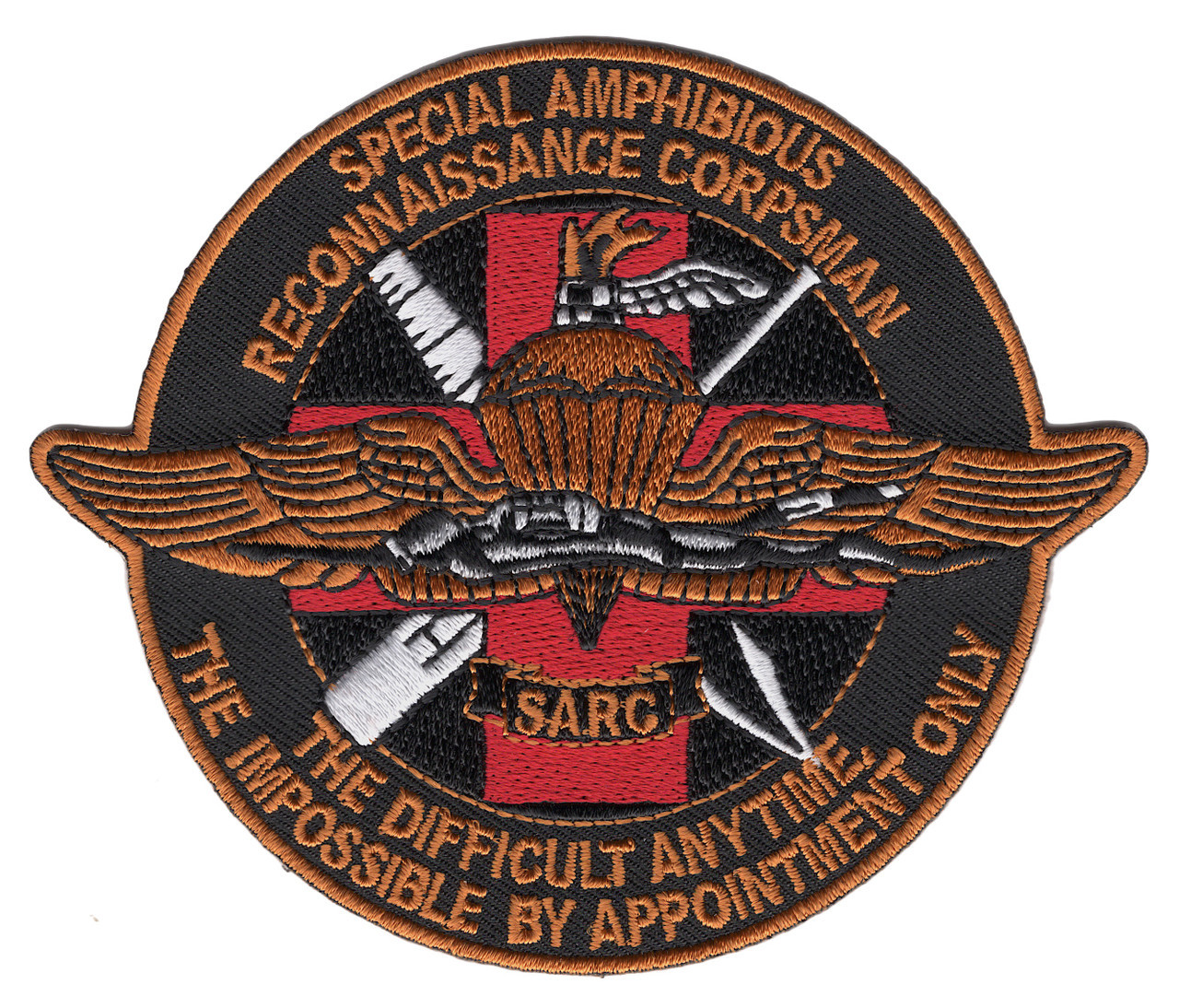
Special Amphibious Reconnaissance Corpsman Patch SARC

- SKU:
- 22
- MPN:
- 22
- Width:
- 4.25 (in)
- Height:
- 3.50 (in)
- Depth:
- 0.08 (in)
- Backing:
- Iron On
- Edging:
- Cut Edge


Description
The Special Amphibious Reconnaissance Corpsman, known by the designation SARC, occupies one of the most demanding intersections in modern military service—where medicine, reconnaissance, and special operations converge. SARCs are not assigned lightly, nor are they trained for routine conditions. Their role exists for environments where evacuation is uncertain, support is distant, and survival depends on the ability to treat trauma while remaining tactically invisible.
The lineage of the SARC is rooted in the long tradition of Navy hospital corpsmen embedded with Marine forces. From island campaigns in the Pacific during World War II to the jungles of Vietnam, corpsmen proved indispensable by providing lifesaving care under fire while sharing the same risks as the units they served. Over time, as reconnaissance and special operations missions grew more complex, the need emerged for corpsmen capable of operating at the same physical and tactical level as elite reconnaissance elements.
SARCs became integral to Marine reconnaissance and special operations formations, particularly those conducting amphibious and maritime missions. These units operated forward of conventional forces, often deployed by sea, air, or submerged insertion. The corpsman assigned to these teams was expected not only to treat injuries, but to maneuver, navigate, and fight alongside the team, carrying advanced medical knowledge into places where mistakes could not be corrected.
During the Cold War and into the post–Cold War era, SARCs refined a dual identity. They were medics trained in trauma care far beyond standard battlefield medicine, and reconnaissance operators trained to survive extended missions in denied environments. From Desert Storm through Operations Enduring Freedom and Iraqi Freedom, SARCs supported missions defined by isolation, precision, and sustained exposure to risk. Their presence allowed teams to operate longer and deeper, knowing that advanced care was immediately available if the mission went wrong.
The culture of the SARC community is shaped by restraint and responsibility. Medical intervention is balanced with mission requirements. Decisions are made with limited resources, under stress, and often without external guidance. The corpsman’s oath—to preserve life—coexists with the realities of reconnaissance warfare, where discretion and discipline are as vital as medical skill.
Within the United States Navy and the Marine units they support, SARCs are trusted implicitly. They are remembered not by rank or recognition, but by outcomes—lives stabilized, teammates returned, missions completed. Their reputation is carried quietly, reinforced by performance rather than proclamation.
Related Products