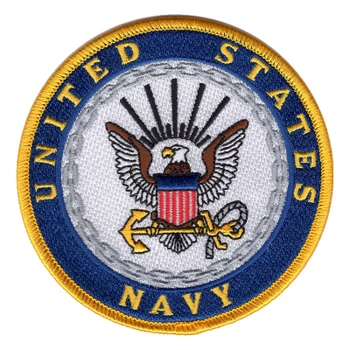
Small Navy Crest Ball Cap Patch
- SKU:
- 13344
- MPN:
- 13344
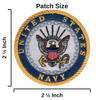
- Width:
- 2.50 (in)
- Height:
- 2.50 (in)
- Depth:
- 0.08 (in)
- Backing:
- Iron On
- Edging:
- Cut Edge


Description
Look closely at the anchor under the eagle and you will see a line looped around its shank, which makes it a fouled anchor, the mark every sailor learns to recognize as the badge of a chief petty officer. To a seaman a fouled anchor is a problem, a hook tangled in its own line. To the Navy it became a symbol of the trials of the sea and the people who get through them. On this patch it sits under an American eagle with a red, white and blue shield on its breast, with UNITED STATES NAVY around the band. It is a small patch, 2.5 inches across, made for spaces where a bigger design will not fit. Every part of it is Navy shorthand that sailors read at a glance.
The Navy dates its birthday to 13 October 1775, when the Continental Congress voted to fit out two armed vessels to intercept British supply ships. The Department of the Navy followed on 30 April 1798. Since then the service has grown into a force that works on, under and above the sea, from aircraft carriers and destroyers to submarines and patrol aircraft. Sailors live by the watch bill, the plan of the day and the rating badge on their sleeve, from boatswain's mate and machinist's mate to hospital corpsman and aviation boatswain's mate. The chief petty officer rate dates to 1 April 1893, and the fouled anchor is the device chiefs wear on the collar.
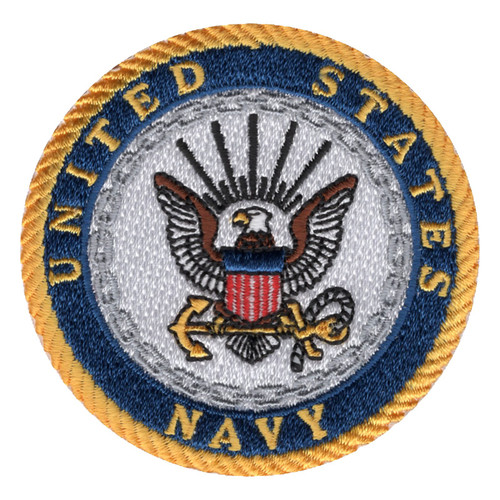
The patch is round, 2.5 inches across, with a gold border around a royal blue band. UNITED STATES arches over the top in gold letters and NAVY reads across the bottom. Inside, a gray stitched chain ring surrounds a white field, a nod to the anchor chain that runs out every time a ship drops the hook. The eagle spreads brown wings beneath dark rays, a red, white and blue shield on its chest, and grips a gold anchor with its line looped through the ring. It is a lot of detail in a small space, and it holds up at arm's length.
Anyone who served knows the sight of an anchor and an eagle on a ship's brow, a recruiting poster or a retirement plaque. The design ties together sailors from the age of sail to the nuclear fleet, every rate and every rank. It turns up on reunion tables, on the dashboards of retired chiefs and on the jackets of Navy families who never wore the uniform but lived around it. A patch this size goes where a sailor goes. It is a quiet way of saying where you served.
The 2.5 inch size was made for small spots, and it presses on with the iron-on backing; a few stitches at the edge hold it on for good. It fits the front of a cover, a jacket chest, a range bag or a small shadow box beside a set of rating badges and ribbons. It makes a good gift for a Navy veteran, a new recruit heading to Great Lakes or a proud Navy parent. Small patch, whole Navy.
Related Products