Shellback King Neptune US Marine Corps Patch

- SKU:
- 14341
- MPN:
- 14341
- Width:
- 4.50 (in)
- Height:
- 3.25 (in)
- Depth:
- 0.08 (in)
- Backing:
- Iron On
- Edging:
- Merrowed Edge


Description
Marines ride Navy ships, so Marines cross the equator, and on that day they answer to King Neptune as pollywogs like every sailor aboard. The crossing the line ceremony is older than the US Navy, and folklorist Keith Richardson traced its main elements as far back as the 1500s. Pollywogs, wogs for short, spend the day on tasks, teasing and trials before they are brought before Neptunus Rex and his court. When it is over they are Shellbacks, with a large certificate and a smaller card to prove it. For a Marine on an amphibious ship heading south, it is one Navy tradition that belongs to him just as much.
The court runs the day. King Neptune presides with his Queen and a Royal Judge to hear the charges against the pollywogs, and photographs from the attack transport USS William P. Biddle show the Royal Judge at work. Guadalcanal and Bougainville lie south of the equator, so the ships that carried Marines there from the States had to cross the line to arrive. Marines embarked on Navy ships have kept crossing the line with the crew ever since. A Marine who has made the crossing carries the same card as the sailor next to him.
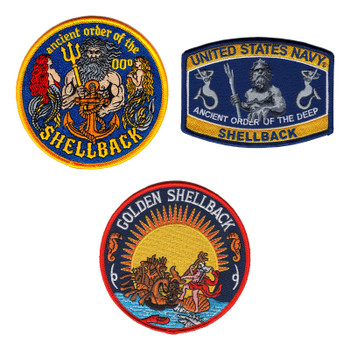
The patch is a wide shape with a curved top and bottom, a red merrowed border and a red field framed in white. MARINE CORPS runs across a black band at the top and SHELLBACK across a black band at the bottom, both in white block letters. King Neptune sits at center in shades of gray, wild-haired and bearded, a trident in his right hand, with ANCIENT ORDER OF THE DEEP arched in white across the red behind him. A gray mermaid on each side, hands behind her head, keeps him company. It measures 4.5 by 3.25 inches with iron-on backing.
The day itself is loud, wet and long, and nobody who went through it forgets it. For a few hours the only rank that counts aboard is wog or Shellback. Marines who went through it on a Navy deck took their place in a sea tradition that is centuries old. The card goes in the wallet and tends to stay there for decades.
Put it in a shadow box next to your Shellback certificate and a photo of the ship that carried you across, or on a vest at a Marine reunion. It is a good gift for a Marine who still has the card and still tells the story. Once a Shellback, always a Shellback.
Related Products