US Naval Hospital Guam Service With Honor Patch
- SKU:
- 12106
- MPN:
- 12106
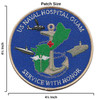
- Width:
- 4.50 (in)
- Height:
- 4.50 (in)
- Depth:
- 0.08 (in)
- Backing:
- Iron On
- Edging:
- Merrowed Edge


Description
Navy medicine on Guam goes back to August 1899, when Surgeon Philip Leach set about building a naval hospital and dispensary at Agana. In its first year the hospital treated 1,141 civilian patients out of an island population of about 9,630. Earthquakes brought down the early buildings in 1902 and 1909, and in 1910 the surviving hospitals became U.S. Naval Hospital Guam, with the first Navy nurses arriving that same year. For more than a century it has been the Navy's hospital at the western edge of American territory. This patch carries that name around a map of the island itself.
The Japanese invasion in December 1941 put the whole hospital staff in captivity, and in January 1942 the mainland staff were shipped to the Zentsuji prisoner of war camp in Japan. The hospital building was destroyed in the August 1944 bombardment that came with the liberation of Guam, and Quonset hut fleet hospitals then cared for about 100,000 service members through the rest of the Pacific War. The hospital moved to its present site in Agana Heights in 1954. It took its first Vietnam War casualties in 1965, and by 1968 and 1969 the daily patient count had climbed from about 100 to more than 700, with the renovated Asan Annex able to hold 1,200 patients. In 1975 it supported Operation New Life, as some 100,000 refugees from South Vietnam passed through Guam.
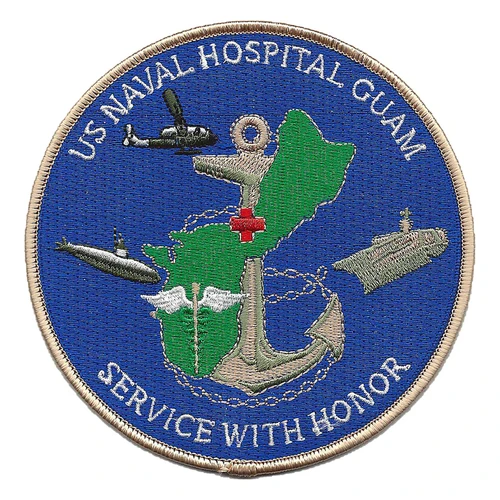
The patch is a 4.5 inch circle with a tan merrowed edge around a royal blue field. US NAVAL HOSPITAL GUAM arcs across the top in white letters, and SERVICE WITH HONOR runs along the bottom. In the center, a green outline of Guam sits behind a tan fouled anchor, its chain looping around the island, with a red cross on the anchor's shank. A white-winged caduceus with green serpents rests on the southern end of the island. A helicopter, a submarine and a flat-deck carrier surround the island, a nod to the ships, boats and aircrews that have come to the hospital for care.
Duty at Naval Hospital Guam has always meant being the closest big Navy hospital to wherever the Western Pacific needed one. Its doctors, nurses and corpsmen carried the Vietnam surge, the 1991 evacuation of personnel and dependents from the Philippines in Operation Fiery Vigil, and the Iraqi Kurd refugees of Operation Pacific Haven in 1996 and 1997. They answered the crash of Korean Air Flight 801 in 1997, and in 2020 they supported COVID-19 patients from USS Theodore Roosevelt CVN-71. A replacement hospital opened in Agana Heights in 2014. Anyone who worked a ward there knows how far from home that island is, and how much depends on the hospital being ready.
The iron-on backing presses onto a jacket, a windbreaker or a canvas bag, and a few stitches around the merrowed edge will hold it through years of wear. It belongs in a shadow box beside a set of orders to Guam and a photo from the tour, or on the vest worn to a corpsman reunion. It also makes a good gift for a Navy nurse or corpsman who spent time on the island. US Naval Hospital Guam, Service With Honor, in one round patch.
Related Products