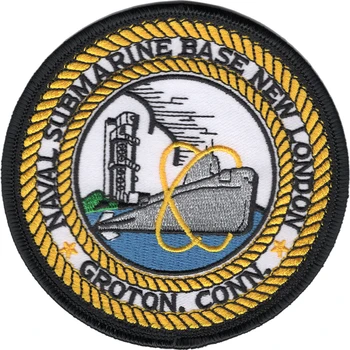
United States Naval Submarine School Patch US Navy Groton

- SKU:
- 13099
- MPN:
- 13099
- Width:
- 5.62 (in)
- Height:
- 4.50 (in)
- Depth:
- 0.08 (in)
- Backing:
- Iron On
- Edging:
- Cut Edge


Description
The school on this patch dates to June 1916, when the yard at Groton was designated a Submarine Base and Submarine School under Commander Yates Stirling Jr., and its first class of officers went straight from New London into World War I. Before that, the land on the Thames River had been given to the Navy by Connecticut in 1868 and spent decades as a coaling station. The Naval Submarine School sits at Naval Submarine Base New London, the home of the US submarine force. For most enlisted submariners it comes after boot camp at Great Lakes and A school. It is where a sailor first learns how a boat is built, how it runs and how it keeps its crew alive.
The Basic Enlisted Submarine School course runs eight weeks and covers submarine construction and operation, shipboard organization, fire safety and escape procedures. Students go through three high-risk trainers in firefighting, damage control and submarine escape, patching leaks and sealing ruptured pipes before the compartment floods. From 1932 to 1992 escape training meant the dive tower, where students rose through a 100-foot column of water. A modern facility replaced it in 1992, and today's trainer has students escape a disabled boat from 40 feet of water. Since 2015 the course has been open to women sailors, and in 2024 the first Royal Australian Navy enlisted sailors began training there.
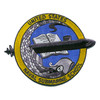
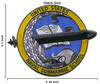
It is a big patch, 5.62 inches wide by 4.5 inches tall, a circle with a gold ring lettered UNITED STATES across the top and NAVAL SUBMARINE SCHOOL along the bottom. Inside, on a blue field, a gray sea serpent with scaled coils wraps around an open book, its head resting at the bottom with a spiral eye and its tail curling over the top. A black submarine crosses the whole design, the bow breaking out past the ring on the right and the screw and stern planes breaking out on the left. The cut edge follows that outline, so the boat really does stick out of the circle. The open book is the classroom side of the trade, and the boat cutting through it is where the classroom leads. The back is iron-on.
For a lot of sailors, Groton was the first place the Navy stopped being boot camp and started being boats. They learned the systems, the escape drills and the damage control, and they learned that a submarine crew carries no passengers. Everything taught there points toward one goal, qualifying aboard and earning dolphins. The school has done that work on the Thames for more than a century, through two world wars and the whole nuclear era.
Press it onto a jacket, or frame it in a shadow box with a set of dolphins, a class photo and a picture of the first boat. It is a good gift for a new graduate heading to the fleet, or a retired chief who still remembers the dive tower. Anyone who went through Groton will know this circle on sight.
Related Products