Naval Intelligence Patch

- SKU:
- 606
- MPN:
- 606
- Width:
- 4.50 (in)
- Height:
- 4.50 (in)
- Depth:
- 0.08 (in)
- Backing:
- Iron On
- Edging:
- Merrowed Edge



Description
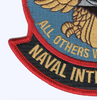
“In God We Trust — All Others We Monitor” is a phrase that captures the essence of Naval Intelligence with stark clarity. It is not a boast, nor a threat, but a statement of discipline and responsibility. Within the United States Navy, intelligence is grounded in humility—an understanding that certainty is rare, assumptions are dangerous, and vigilance is essential. The phrase reflects a worldview shaped by oceans without borders and adversaries who rarely announce intent.
Naval Intelligence emerged from the realization that maritime power depends as much on awareness as on firepower. From its earliest days, intelligence officers and analysts were tasked with observing patterns, tracking movements, and understanding capabilities long before confrontation occurred. Ships could be built and crews trained, but without accurate intelligence, power at sea was blind. Monitoring became a form of stewardship, ensuring decisions were informed rather than reactive.
During World War II, Naval Intelligence demonstrated the meaning behind the phrase in practice. Analysts assessed enemy fleets, shipping routes, and industrial capacity, enabling commanders to act with precision rather than guesswork. The success of naval campaigns often hinged on information quietly gathered, carefully evaluated, and cautiously disseminated. Trust was placed in analysis, not assumption.
The Cold War elevated monitoring to a strategic imperative. Submarines slipped beneath the surface, fleets maneuvered across contested waters, and global stability depended on knowing what moved where—and why. Naval Intelligence tracked adversary behavior relentlessly, understanding that misinterpretation could escalate into catastrophe. In this era, monitoring was not about aggression, but about restraint informed by clarity.
Modern naval operations expanded the scope but not the principle. From Vietnam through Desert Storm and into the long campaigns of the post–Cold War world, Naval Intelligence supported maritime security, strike planning, counterterrorism, and deterrence. Technology accelerated collection, but judgment remained the decisive factor. The phrase endured because it reflected an unchanging truth: information must be questioned, verified, and contextualized.
The culture behind Naval Intelligence values discretion above recognition. Professionals in this field accept that their successes may never be visible, measured instead by crises prevented and missions executed without surprise. “All Others We Monitor” is not cynicism—it is professionalism. It acknowledges the responsibility of vigilance in a world where the sea connects every nation.
Within the United States Navy, the phrase has become an unofficial maxim, expressing the balance between faith, duty, and analysis that defines naval intelligence work. It honors a legacy of quiet service carried out far from attention, yet central to every fleet operation.
Related Products