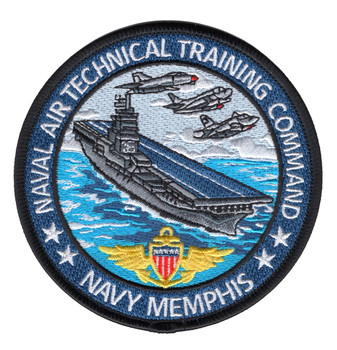
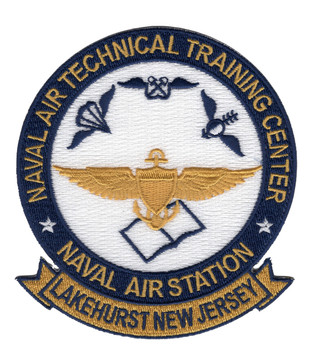
Millington Tennessee Naval Air Technical Training Center Patch

- SKU:
- 6790
- MPN:
- 6790
- Width:
- 4.50 (in)
- Height:
- 4.50 (in)
- Depth:
- 0.08 (in)
- Backing:
- Iron On
- Edging:
- Cut Edge

Description
Inland and far from any ocean, the Naval Air Technical Training Center at Millington, Tennessee became one of the most critical installations in the history of United States Navy aviation. Known throughout the fleet simply as NATTC Millington, it was here that the Navy trained the specialists who made carrier air power possible—aviation machinist’s mates, aviation electricians, aviation ordnance personnel, and airframe mechanics whose work determined whether aircraft launched, recovered, and survived combat.
During World War II, Millington rose rapidly in importance as naval aviation expanded across the Pacific and European theaters. Aircraft carriers such as USS Enterprise, USS Yorktown, USS Essex, and USS Hornet depended on a constant flow of trained aviation technicians. NATTC Millington supplied that expertise, transforming civilians into highly disciplined sailors capable of maintaining aircraft like the F6F Hellcat, SBD Dauntless, TBF Avenger, and SB2C Helldiver under combat conditions.
The training conducted at Millington was exacting and relentless. Students learned aircraft engines, electrical systems, hydraulics, weapons loading, and structural repair to standards dictated by combat necessity. The curriculum reflected the realities of carrier operations—salt air corrosion, battle damage, limited parts, and extreme time pressure. Graduates were expected to keep aircraft flying aboard fleet carriers, escort carriers, and shore-based squadrons supporting operations across the Pacific island-hopping campaign.
As World War II transitioned into the Cold War, NATTC Millington adapted to a new era of naval aviation. Jet aircraft, advanced avionics, and increasingly complex weapons systems reshaped training pipelines. Sailors trained at Millington went on to support fleet operations involving aircraft such as the F9F Panther, FJ Fury, A-4 Skyhawk, and later generations of naval aircraft. The base quietly underpinned carrier strike groups operating in the Mediterranean, Atlantic, and Western Pacific during a period defined by deterrence and readiness.
The Vietnam War further reinforced Millington’s relevance. Aviation technicians trained there supported sustained carrier operations aboard ships like USS Midway, USS Kitty Hawk, USS Coral Sea, and USS Constellation. Sortie rates were high, turnaround times were short, and maintenance failures were unacceptable. The skills learned at NATTC Millington directly translated to combat effectiveness, often determining whether aircraft could launch again within hours.
Beyond combat, the culture of Millington emphasized accountability and precision. Sailors learned early that aviation maintenance was unforgiving—small errors carried large consequences. The base developed a reputation across the Navy as a place where standards were enforced and competence was earned. For generations of sailors, Millington marked the transition from trainee to trusted aviation professional.
Though the training mission eventually shifted and the installation evolved, the legacy of the Naval Air Technical Training Center at Millington remains deeply embedded in naval aviation history. Every successful carrier launch, every recovered aircraft, and every sustained air campaign owes something to the technicians trained far from the coast, long before the flight deck came into view.
2 Reviews
-
Just what I was looking for
Good quality and arrived quickly!! Thanks
-
This patch shown in review above.
Very well done. Colors are brilliant. Exactly what I wanted to remember my old duty station.
Related Products