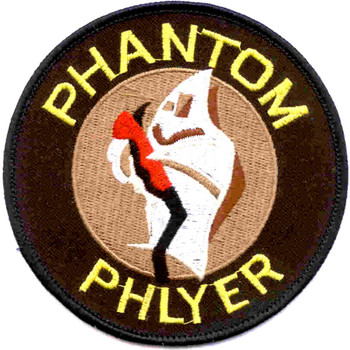
McDonnell Douglas F-4EJ Super Phantom Patch

- SKU:
- 5999
- MPN:
- 5999
- Width:
- 4.50 (in)
- Height:
- 4.50 (in)
- Depth:
- 0.08 (in)
- Backing:
- Iron On
- Edging:
- Merrowed Edge


Description
The last F-4 Phantom II ever delivered was not built in St. Louis; it was F-4EJ serial 17-8440, handed over in Japan on 20 May 1981. Japan bought 140 F-4EJs for the Japan Air Self-Defense Force, most of them built under license by Mitsubishi Heavy Industries in Nagoya. The F-4EJ was the Japanese version of the F-4E, and it carried the JASDF's fighter mission for close to five decades. Plenty of American Phantom crews never knew that the line that started at McDonnell ended on the other side of the Pacific. This patch is for the EJ and the people who flew it, fixed it and watched it go.
The JASDF brought the jet into service in 1972, when 301 Hikotai brought it to Hyakuri Air Base. As first delivered, the EJ was an air defense fighter, armed with the M61 cannon and AIM-9 Sidewinders for close-in fighting. Work on a service life extension began in 1982, and 96 airframes came out of it as the F-4EJ Kai, with an APG-66J radar under a modified radome, air-to-air refueling restored and air-to-ground and anti-ship capability added. 301 Hikotai moved to Nyutabaru in 1985, took the Kai there and returned to Hyakuri in 2016. The 501 Hikotai reconnaissance squadron flew the RF-4E and RF-4EJ until 2020.
The patch is a 4.5 inch circle of olive drab twill with an olive merrowed edge, the low-visibility look of a flight suit shoulder. SUPER PHANTOM arches across the top in olive-tan thread, with F-4EJ stitched beneath it inside an inner ring. Behind the jet a large Japanese brush-stroke character fills the center, stitched in the same muted tan. The Phantom comes straight at you in gray and white, light blue canopy, red stripes on the wingtips, tanks hanging under the wings and those drooped stabilators showing below the fuselage. It is a quiet design that rewards a second look.
Japan kept its Phantoms flying for nearly half a century. On 20 November 2020, 301 Hikotai held its farewell at Hyakuri after 48 years of JASDF Phantom service, and three jets flew one last time after the ceremony. The squadron moved on to the F-35A at Misawa, and a few Phantoms stayed on at the Air Development and Test Wing at Gifu for a short time after. For the maintainers who kept 1970s airframes flying into the 2020s, the EJ was a career. For American Phantom people, it is the cousin that kept the family name alive on the far side of the Pacific.
Press it onto a flight jacket or a canvas bag with the iron-on backing, or put a few stitches around the edge for heavy use. It sits well in a shadow box with USAF or Navy F-4 Phantom II squadron patches, a reminder that the same airframe served on both sides of the Pacific. It also makes a good gift for a Phantom Phixer or a scale modeler building a JASDF jet. The last Phantom off the line, on olive drab.
Related Products