United States Marine Corps Small Emblem Patch

- SKU:
- 13285
- MPN:
- 13285
- Width:
- 2.50 (in)
- Height:
- 2.50 (in)
- Depth:
- 0.08 (in)
- Edging:
- Cut Edge


Description
The Eagle, Globe and Anchor was approved on 19 November 1868, when the Secretary of the Navy signed off on the design a board appointed by Brigadier General Commandant Jacob Zeilin had reported out six days earlier. Marines have worn it ever since. Its general design probably owes something to the Globe and Laurel of the British Royal Marines. Every piece of it means something to the men and women who wear it. This small round patch puts all of it on 2.5 inches of cloth.
The globe shows the Western Hemisphere and stands for service in any part of the world. The fouled anchor goes back to the Corps' founding in 1775 and stands for the amphibious nature of Marine duty. The eagle on the 1868 design was a crested eagle, and the version with an American bald eagle dates to 1955. The ribbon above it carries Semper Fidelis, though it is left off the uniform ornaments.
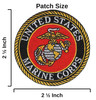
The patch is a 2.5 inch round with a twisted gold rope border. Inside it, a black ring carries "UNITED STATES MARINE CORPS" in white serif letters. The center is scarlet, with a gold eagle on top holding a white ribbon in its beak. Below it the globe is stitched in white with gold continents, and the gold anchor runs behind it with its line wrapped around the shank and flukes. Scarlet and gold are the Corps' colors, and the patch keeps to them.
Marines carried this emblem at Belleau Wood, Iwo Jima, the Chosin Reservoir, Hue City and Fallujah. It is handed to recruits at the end of boot camp, and from that day it belongs to them for life. Rank and MOS do not change it; the rifleman, the aviator and the mechanic wear the same one. That is why a Marine who did four years in the 1960s and a Marine who just finished the Crucible will both recognize this patch from across a room.
At 2.5 inches it fits a vest, a range bag, a laptop sleeve or a corner of a shadow box with dog tags and a photo from boot camp. It is also a good gift for a new Marine or a parent who just watched one graduate. Measures 2.5 x 2.5 inches with a cut edge.
Related Products