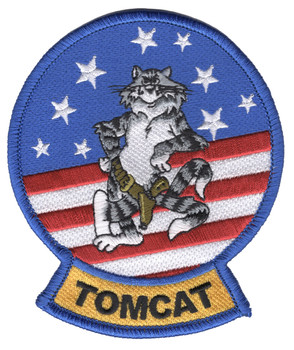
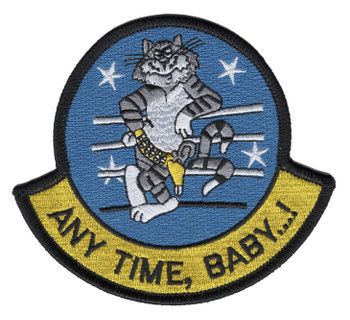
F-14 Tomcat F110-GE-400 Speed Is Life Baby Embroidered Patch

- SKU:
- 6882
- MPN:
- 6882
- Width:
- 4.00 (in)
- Height:
- 4.00 (in)
- Depth:
- 0.08 (in)
- Backing:
- Iron On
- Edging:
- Merrowed Edge

Description
"Speed Is Life Baby!!"
Those three words meant everything to the men who flew and maintained the F-14 Tomcat — especially those who flew her in the B and D variants, the machines that ran on the thundering heart of a General Electric F110-GE-400 turbofan. It wasn't a bumper sticker. It was doctrine. It was survival. And when you had a pair of those GE engines screaming behind you at full burner, pulling you into the sky off a carrier deck without even needing the afterburner to do it, you understood exactly what the phrase meant.
The story of the F110-GE-400 is, in many ways, the story of the Tomcat's redemption. For fifteen years, the F-14 operated with engines the Navy never truly wanted in the first place National Security Journal — the Pratt & Whitney TF30, a powerplant designed for the very different demands of the F-111 Aardvark. In the Tomcat's airframe, the TF30 was notoriously unforgiving. Compressor stalls during high-angle-of-attack maneuvering were a constant hazard. Pilots had to manage their throttles with the delicacy of a surgeon during combat — a fatal limitation when seconds separated the hunter from the hunted. Maintainers logged crushing hours keeping the engines airworthy. The TF30 wasn't just a mechanical problem. It was a tactical one.
In August 1984, the Navy awarded Grumman a contract for improved versions of the F-14, and the troublesome TF30 would be replaced by the F110-GE-400. Joe Baugher The results were transformative. The new F110 engines offered fewer compressor stalls, more unrestricted throttle movement throughout the entire flight regime, improved fuel economy, a 62-percent increase in mission radius, and a 61-percent reduction in time to high altitude. Joe Baugher Perhaps most critically, the pilot could at long last forget about his engine during combat maneuvers and move the throttles shut or wide open no matter what the angle of attack or airspeed — without having to worry about the danger of a compressor stall. Joe Baugher That was freedom. Real freedom. The kind you can only understand if you've sat in the front seat of a Tomcat knowing that the machine behind you is finally, fully, on your side.
The F-14A aircraft that underwent engine upgrades to the GE F110-GE-400 beginning in 1987 were redesignated F-14A+, later changed to F-14B in 1991. Fandom The final variant, the F-14D Super Tomcat, first delivered in 1991, was also equipped with the F110-GE-400 engines, paired with a glass cockpit and the advanced AN/APG-71 radar. Wikipedia These were the aircraft that carried naval aviation into the 1990s and beyond — conducting combat operations over Bosnia, Iraq, and Afghanistan; flying TARPS reconnaissance missions; delivering precision-guided munitions with the LANTIRN targeting pod. The F110-powered Tomcat was the aircraft's definitive form. And the aviators and maintainers who served with it knew they were flying something special.
About the Patch Design
Set against a rich navy blue background with a bold gold merrowed border, this patch announces itself immediately. Arching across the top in fiery red block letters is the legendary phrase: SPEED IS LIFE BABY!! — punctuated with double exclamation marks, because once was never enough. At the center, a white and blue Tomcat — the Grumman mascot rendered in the classic cartoon style beloved in naval aviation ready rooms — straddles a pair of F110-GE-400 turbofan engines. The engines are rendered in stunning detail: the characteristic silver-gray casing, the compressor face on the right rendered with visible blade detail, and the turbine exhaust on the left. The cat grips the engines confidently, even triumphantly, while below, an explosion of yellow, orange, and red flame bursts from the afterburner nozzle area — raw thrust made visible. At the bottom, in clean gold embroidered lettering: F-110 • GE • 400. The design doesn't just commemorate a piece of machinery. It captures the attitude — the irreverence, the confidence, the dark humor — of the men and women who flew and maintained the most iconic fighter the United States Navy has ever put to sea.
This is a patch for the aviator who remembers what it felt like to push those throttles forward and feel the world compress. For the aviation machinist's mate who pulled wrenches on those GE engines on a midnight flight deck in the middle of the North Atlantic. For the RIO who trusted his pilot and that engine to get him home. For anyone who loves the Tomcat — not as a movie prop, but as the living, roaring, legendary machine it truly was.
At 4 inches in diameter with a durable embroidered construction, merrowed edge, and iron-on backing, this patch is built to last and ready to display — on a flight jacket, a shadow box, a museum-quality collection, or anywhere the Tomcat's memory lives. It's a piece of naval aviation history you can hold in your hands.
Honor the engine.
Honor the aircraft. Honor the service. Carry that legacy with you.
Related Products