
Diego Garcia Naval Support Facility Patch

- SKU:
- 605
- MPN:
- 605
- Width:
- 4.00 (in)
- Height:
- 4.00 (in)
- Depth:
- 0.08 (in)
- Backing:
- Iron On
- Edging:
- Merrowed Edge



Description
The first Seabees stepped ashore on Diego Garcia on 23 January 1971, and the coral atoll they started building on sits about seven degrees south of the equator in the middle of the Indian Ocean. Five years of work turned a coconut plantation into a deep-water anchorage and a 12,000-foot runway. On 1 October 1977 the Navy set up Naval Support Facility Diego Garcia as its senior command on the island. The island belongs to the British Indian Ocean Territory, and the base has always been a joint U.S. and British post. Sailors call it the Footprint of Freedom for the shape of the atoll on a map.
In 1980 the Navy began its prepositioning program, and Maritime Prepositioning Squadron Two grew to about 20 loaded logistics ships riding at anchor in the lagoon. The Naval Computer and Telecommunications Station was the main tenant in the early years. B-52 Stratofortresses began deploying to the island in 1987, and during the Gulf War B-52Gs flew more than 200 missions from its runway. On 7 October 2001 B-1B Lancers and B-52s from Diego Garcia joined B-2 Spirits in opening the air campaign over Afghanistan, and bombers flew from there again over Iraq in 2003. Navy patrol squadron detachments have rotated through as well, first P-3C Orions and now P-8A Poseidons.
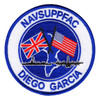
This round patch has a white ring inside a blue merrowed border, with NAVSUPPFAC across the top and DIEGO GARCIA across the bottom in blue block letters. In the center, on a blue field, the white outline of the atoll curls up the middle, the footprint everyone who served there knows. A Union Jack and the Stars and Stripes cross on black staffs above it, the two flags that fly over the island. Black silhouettes of a ship and an aircraft line up along a single horizon, the anchorage and the runway that are the whole reason the base exists. It reads clean from across a room.
Diego Garcia is one of the most isolated duty stations in the Navy, a year of heat, reef and the same few miles of road. There is no town outside the gate and no family housing, so the people who served there remember each other. What they did there kept ships loaded, bombers fueled and messages moving for every major operation in the region from Desert Storm on. Seabees, sailors, airmen and British forces all shared the same small island. Ask anyone who did a tour and you will get an hour of stories.
The patch measures 4 by 4 inches with a merrowed edge and iron-on backing, and it can also be sewn on. Frame it in a shadow box with photos from your tour, or put it on a jacket or vest for the next reunion. It makes a good gift for a Seabee, sailor or airman who did his year on the island. One small atoll, a long way from home.
Related Products


