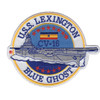
CV-16 USS Lexington Patch

- SKU:
- 4658
- MPN:
- 4658
- Width:
- 5.00 (in)
- Height:
- 4.00 (in)
- Depth:
- 0.08 (in)
- Backing:
- Iron On
- Edging:
- Cut Edge




Description
She earned her nickname the hard way—through fire, smoke, and survival in the vastness of the Pacific. The USS Lexington (CV-16), forever known as “The Blue Ghost,” was one of the most battle-tested aircraft carriers of World War II. Where she sailed, airpower followed. Where she fought, victory was never far behind.
Commissioned in 1943 as an Essex-class aircraft carrier, Lexington entered the war at a moment when the United States was shifting from survival to dominance in the Pacific. Assigned to the fast carrier forces of Task Force 58 and later Task Force 38, she became part of the hammer that would break Imperial Japan’s ability to wage war. Her flight deck quickly filled with Hellcats, Helldivers, and Avengers—aircraft flown by young men who learned fast or did not return.
Lexington first tasted combat during raids across the Central Pacific, striking Japanese strongholds and airfields that had once seemed untouchable. She played a key role in the Battle of the Philippine Sea, where American naval aviation shattered Japanese carrier airpower in what became known as the “Great Marianas Turkey Shoot.” From her decks, fighters rose to intercept wave after wave of enemy aircraft, ensuring that the balance of power in the Pacific tipped permanently in America’s favor.
Her legend was sealed in October 1944 during the Battle of Leyte Gulf, the largest naval battle in history. As U.S. forces closed in on the Philippines, Lexington launched strikes against enemy carriers, battleships, and cruisers. It was there that she survived devastating kamikaze attacks—fires raging, smoke billowing, casualties mounting—yet she stayed in the fight. Japanese pilots believed they had sunk her, and propaganda broadcasts claimed the Lexington destroyed. But she returned again and again, her blue camouflage making her appear ghostlike through smoke and haze. The name Blue Ghost stuck, carried by sailors who knew she refused to die.
Despite multiple hits, Lexington continued launching aircraft, supporting the liberation of the Philippines and strikes against the Japanese home islands. Her air wing attacked airfields, shipping, and industrial targets, tightening the noose around a collapsing enemy. By war’s end, she had earned 11 battle stars, a testament to relentless service under fire.
After the war, Lexington’s mission changed, but her importance did not. She became a training carrier, shaping generations of naval aviators during the Cold War. Thousands of pilots made their first carrier landings on her deck, learning the unforgiving discipline of naval aviation aboard a ship whose own history demanded excellence. For decades, she trained the men who would later fly jets in Korea, Vietnam, and beyond.
Today, Lexington rests as a museum ship, her decks quiet but her legacy loud. She stands as a reminder that carriers are not just platforms—they are living instruments of history, shaped by the sailors who fight fires, launch aircraft, and refuse to yield even when the sea itself seems against them.
The USS Lexington CV-16 patch honors the Blue Ghost and the men who served aboard her. It represents survival against all odds, dominance in the Pacific, and a carrier whose spirit never faded, even when the world believed she was gone.
Related Products