Commander Joint Task Force Middle East Embroidered Patch
- SKU:
- 10399
- MPN:
- 10399
- Width:
- 4.00 (in)
- Height:
- 4.00 (in)
- Depth:
- 0.08 (in)
- Backing:
- Iron On
- Edging:
- Merrowed Edge


Description
The motto "Vis In Unitate" -- Strength in Unity -- was not a formality on this patch; it was the operating principle of a joint headquarters that had to make four services function as one across the Persian Gulf theater. Commander Joint Task Force Middle East represented the senior U.S. military authority over a region that included the Persian Gulf, the Gulf of Oman, Red Sea approaches, and approaches to the Strait of Hormuz. The command coordinated Navy surface action groups, carrier air wings, Air Force strike and airlift assets, Army ground and logistics elements, and Marine expeditionary units under a single chain of command at a time when that region allowed no margin for inter-service friction. Wearing this patch meant you sat close to the top of that structure.
CJTF-ME operated during the late Cold War and Gulf War era, a period when the Persian Gulf went from a strategic concern to an active combat theater almost overnight. Operations Earnest Will and Prime Chance in the late 1980s put U.S. forces in direct confrontation with Iranian Revolutionary Guard forces in the Gulf, and CJTF-ME was the command layer that held it together. When Operations Desert Shield and Desert Storm followed in 1990 and 1991, the joint task force framework that had been built and tested through those earlier missions provided the architecture for one of the largest coalition operations since World War II. The command's area of responsibility was never a quiet theater, and the patch reflected that with the anchor of naval authority anchored beneath a shield showing the Arabian Peninsula from Saudi Arabia to the Gulf waters.
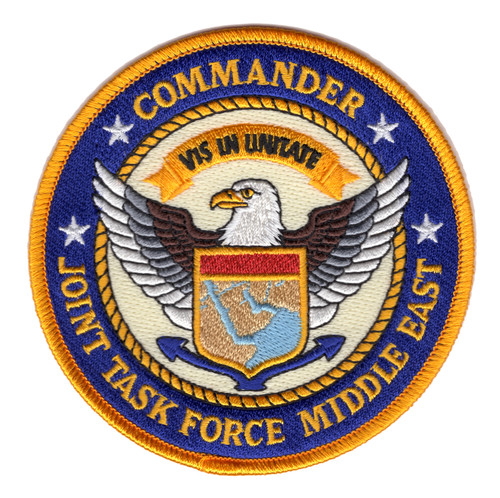
The patch is circular, approximately 4 inches across, with a gold merrowed border surrounding a royal blue outer ring. "COMMANDER" arcs across the top in gold lettering, and "JOINT TASK FORCE MIDDLE EAST" runs along the bottom, both separated by five-pointed white stars on either side. The center field is cream-colored, ringed by a gold rope border, and features a bald eagle with wings spread wide, rendered in silver-gray and brown, gripping a blue naval anchor beneath a heraldic shield depicting the Arabian Peninsula in tan and pale blue. Above the eagle, a gold banner carries the Latin motto "VIS IN UNITATE." The imagery connects directly to the joint nature of the command: the eagle for American authority, the anchor for naval primacy in the Gulf, and the map for the specific geography that defined every decision made at that headquarters.
Commands like CJTF-ME rarely get the historical attention that individual units or named operations receive, but anyone who served in or worked adjacent to that headquarters understood what it meant to be there. The command absorbed the lessons of the tanker wars, adapted to the rapid buildup of Desert Shield, and maintained operational coherence across a coalition that included dozens of partner nations alongside U.S. forces. The personnel who rotated through that headquarters -- Navy flag officers, Air Force colonels, Army staff officers, Marine liaisons -- operated under pressure that did not let up for years. When CJTF-ME eventually transitioned into what became U.S. Central Command's maritime component, the institutional knowledge built there went with it.
This patch mounts cleanly in a shadow box next to theater medals, carrier air wing patches, or Gulf War ribbons. It fits naturally on a vest for squadron or unit reunions where the people who understand the geography on that shield will recognize it immediately. For family members looking for something that captures the scope of a Gulf-era assignment, this is the kind of specific, command-level piece that a shadow box display is built around. The iron-on backing makes attachment straightforward on any textile surface.
Related Products