
Combined Joint Special Operations Task Force Afghanistan Round Patch
- SKU:
- 10238
- MPN:
- 10238
- Width:
- 4.00 (in)
- Height:
- 4.00 (in)
- Depth:
- 0.08 (in)
- Backing:
- Iron On
- Edging:
- Merrowed Edge
- Era:
- Afghanistan & Iraq (GWOT)


Description
CJSOTF-A was formed on March 15, 2002, out of Task Force K-Bar in the south and Task Force Dagger in the north, and it ran special operations in Afghanistan from Bagram for the next twelve and a half years. Dagger had been built around the 5th Special Forces Group (Airborne) with the 160th Special Operations Aviation Regiment and the Air Force 16th Special Operations Wing. K-Bar was built around Naval Special Warfare Group One and coalition special operations forces. The new Combined Joint Special Operations Task Force-Afghanistan took operational control of joint SOF and tactical control of coalition SOF in the country. Colonel Mark V. Phelan of the 3rd Special Forces Group took command at Bagram Airbase on March 30, 2002.
The mission passed from group to group in rotation. The 3rd SFG(A) took it first, and the National Guard's 20th SFG(A) assumed it in September 2002 for six months. In July 2009, ODA 7224 set up the first Community Defense Initiative site at Nili in Daykundi Province, the program that grew into Village Stability Operations. That August, USSOCOM gave the 3rd Group primary responsibility for Afghanistan, with the 7th Group assisting. From April 2010 the task force's special operations task forces worked in direct support of the conventional Regional Commands, and village stability and foreign internal defense became the main effort.
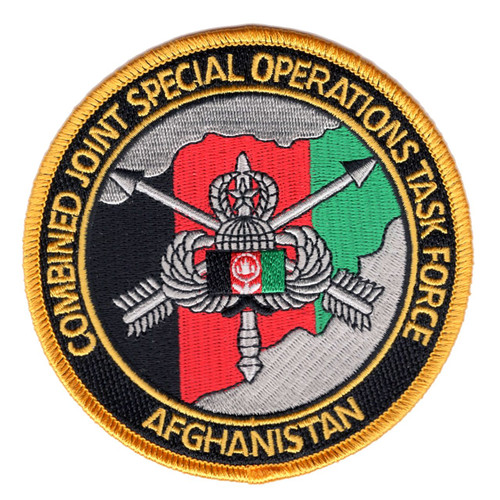
The patch is a 4 inch circle with a gold merrowed edge around a black ring. COMBINED JOINT SPECIAL OPERATIONS TASK FORCE arcs across the top in gold block letters, with AFGHANISTAN across the bottom. Inside a thin gold ring, the map of Afghanistan is stitched in vertical bands of black, red and green against the gray of its neighbors. Crossed arrows, the mark of Special Forces, span the map behind a silver military freefall parachutist design: the ram-air canopy, spread wings, a Fairbairn-Sykes dagger, and the star and laurel wreath of the master rating above. A small Afghan flag sits across the canopy.
CJSOTF-A was where Green Berets, SEALs, aviators, air commandos and coalition partners came under one headquarters. The work ran from training the first battalions of the Afghan National Army to living in remote villages alongside local defense forces. Teams spent rotation after rotation in places few outsiders ever saw, and many came home with the names of teammates they lost. The task force was deactivated at Camp Vance on Bagram on October 31, 2014, and Special Operations Task Force-Afghanistan took over the advise and assist mission the next day. For those who worked under it, the name still means a specific place and a specific stretch of years.
Put it in a shadow box with your group flash, your freefall wings and a photo from Bagram or a firebase. It also fits on a team room plaque, a range bag or the jacket you wear to a group reunion. The backing is iron-on, and it can be sewn on for a permanent hold. Twelve years of rotations, one patch.
Related Products


