
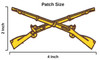
Army Infantry Crossed Rifles Patch

- SKU:
- 12984
- MPN:
- 12984
- Width:
- 4.00 (in)
- Height:
- 2.00 (in)
- Depth:
- 0.08 (in)
- Backing:
- Iron On
- Edging:
- Cut Edge


Description
Look closely at the crossed rifles on this patch and you will see they are not rifles at all, but a pair of flintlock muskets, each with its lock, hammer and trigger guard stitched in brown. The infantry has called its branch mark the crossed rifles for generations, and the old smoothbore muskets are a reminder of how far back the branch goes. The infantry traces its start to the riflemen and musket companies of 1775, and it is the oldest fighting arm of the Army. Every other branch exists to put the infantryman where he needs to be and keep him there. The crossed rifles are what he wears to say he is the one who closes with the enemy.
An infantryman is an 11B rifleman or an 11C indirect fire infantryman on the mortars, and he knows the rest of the alphabet that comes with it. He wears the light blue infantry cord on his dress uniform and the crossed rifles on his collar. If he earned it, he wears the Expert Infantryman Badge from the testing lanes, or the Combat Infantryman Badge from the real thing, and he knows the difference better than anyone. The branch calls itself the Queen of Battle, and the Infantry School's motto is "Follow Me." He learned the job in Georgia, at Infantry School, and carried it from the rice paddies to the mountains of Afghanistan.
This patch is cut edge, trimmed to the outline of the two muskets so there is no background around them. It measures 4 inches wide by 2 inches tall and has an iron-on backing, and it can be sewn on as well. The muskets are stitched in bright gold twill and outlined in brown, crossed at the middle with the barrels up and the butt stocks down and out. The detail is in the hardware: barrel bands, the lock and hammer on each side, the trigger guards and the flat of each stock. It reads clearly from across a room, and it reads as infantry to anyone who ever wore the blue cord.
The infantry does the closest and hardest work in any war, and the men who served in it know that without being told. Squads and platoons are where the work happens, and the bonds made there do not loosen with age. Infantrymen from every era recognize each other by the crossed rifles before they ever ask what unit. A Korea rifleman, a Vietnam grunt and a soldier from Fallujah or the Korengal can stand at the same table and share the same shorthand. That shared mark is the whole point of this patch.
It fits a jacket, a vest worn to a reunion, a range bag or a ruck, and it pairs well in a shadow box with a CIB, a unit crest and a photo from the field. A son or grandson heading to infantry training will want one, and so will the old grunt in the family. Follow Me still means what it meant.
Related Products


