
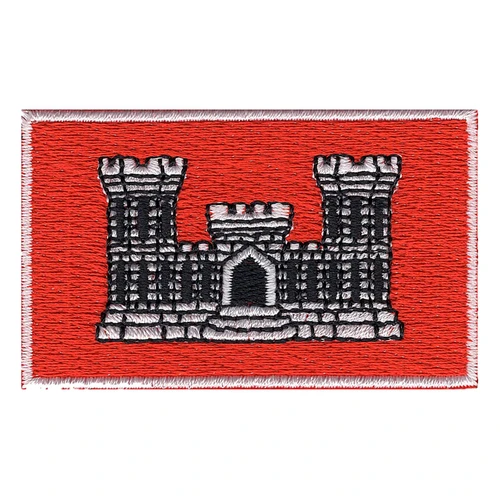
US Army Corps of Engineers Castle Patch
- SKU:
- 8870
- MPN:
- 8870
- Width:
- 2.50 (in)
- Height:
- 1.50 (in)
- Depth:
- 0.08 (in)
- Backing:
- Iron On
- Edging:
- Cut Edge


Description
The castle on this patch went into informal Engineer use in 1840, and West Point cadets commissioned into the Engineers were wearing gold castles by 1841. The Army made it the formal insignia of the Corps of Engineers in 1902. The motto that goes with it, Essayons, is French for "let us try," and it was already on the Engineer button described in General Orders in February 1840. Engineers have carried both through every war the Army has fought since. This patch is the castle alone, white on red, with nothing added.
Engineers were part of the Army from its first months. The Continental Congress organized engineers on June 16, 1775, with Col. Richard Gridley as General Washington's first chief engineer, and one of his first jobs was fortifying Bunker Hill. Congress created a separate Corps of Engineers under Louis Duportail in May 1779, and on March 16, 1802, Thomas Jefferson signed the Military Peace Establishment Act that made the Corps permanent and tied it to the new Military Academy at West Point. In the Civil War, Engineer officers built the pontoon and railroad bridges, forts, batteries and roads that kept armies moving. At Normandy in 1944, specially trained combat engineers were assigned to blow up the underwater obstacles and clear defended ports, and at home the Corps built the Pentagon in 16 months and carried out the construction of the Manhattan Project.
The patch is a small rectangle, 2.5 inches wide and 1.5 inches tall, with a cut edge finished in a thin white border. The field is solid red, and the castle sits in the middle in white thread outlined in black. Two tall crenellated towers stand at the ends, a lower turret rises over the center, and an arched gate opens at the base above a set of stone steps. Black outlining picks out every course of stone and every window slit, so the castle reads clearly from across a room. Red and white are the colors the Corps castle is customarily shown in.
The Corps does two jobs at once, and the castle covers both. Today it is about 37,000 people, roughly 97 percent of them civilians, and it directly controls 609 dams and keeps more than 230 navigation locks working. Lt. Col. Thomas Lincoln Casey's Engineers completed the Washington Monument in 1884, Army Engineer officers supervised the Panama Canal to its finish in 1914, and the Mississippi River and Tributaries Project has been Corps work since 1928. The same castle is worn by combat engineers clearing a route and by the people running a lock on an inland river. Essayons has been the answer from both sides for nearly two centuries.
At 2.5 by 1.5 inches it fits a jacket sleeve, a range bag or a corner of a shadow box with castle collar brass and a unit coin. It also makes a good gift for a new engineer lieutenant, or for a retired district employee who spent a career on the river. The backing is iron-on, and it can be sewn on as well. Essayons.
Related Products


