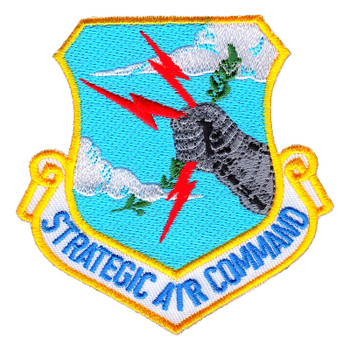
Strategic Air Command Banner Patch
- SKU:
- 6033
- MPN:
- 6033
- Width:
- 7.50 (in)
- Height:
- 4.50 (in)
- Depth:
- 0.08 (in)
- Backing:
- Iron On
- Edging:
- Cut Edge
- Era:
- Cold War




Description
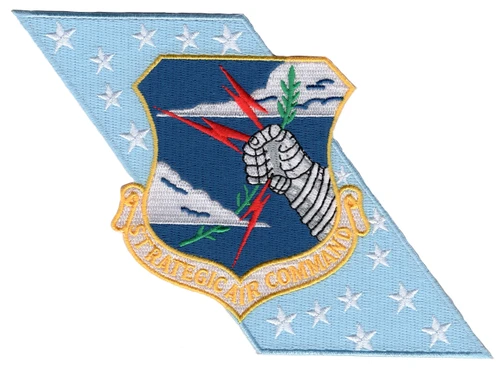
SAC bombers and tankers wore a slanted blue band full of white stars across the fuselage, and this patch is cut in that same shape. Crews called it the Milky Way. Bombers carried it in the area of the cockpit, while tankers and airborne command posts wore it at mid-fuselage, always running on a slant from about eleven o'clock down to five. Paired with the shield, it told anyone on the ramp whose airplane they were looking at. The stripe even showed up on the missiles of the strategic force. Strategic Air Command owned America's long-range bombers and land-based missiles for most of the Cold War.
SAC was activated on 21 March 1946 and moved its headquarters to Offutt Air Force Base, Nebraska, in 1948. Its bomber line ran from the B-29 Superfortress and the B-36 Peacemaker through the B-47 Stratojet to the B-52 Stratofortress, with KC-135 Stratotankers keeping them in the air. At Fairchild AFB, Washington, B-52s went on 24-hour ground alert on 7 January 1958 and stayed on continuous nuclear alert until 28 September 1991. Chrome Dome kept armed B-52s airborne around the clock through much of the 1960s, while Titan and Minuteman crews stood their own watches underground. The motto painted on the hangars said it in four words: Peace is Our Profession.
The patch measures 7.5 inches wide by 4.5 inches tall, a light blue band with white stars, finished with a cut edge and an iron-on backing. In the center sits the SAC shield, a blue sky with white clouds and a silver armored arm whose gauntlet grips a green olive branch and three red lightning bolts. One fist holding both the branch and the bolts is the whole idea of deterrence in a single picture. The shield came out of a command-wide contest in late 1951, won by Staff Sgt. R.T. Barnes, an intelligence specialist with the 92nd Bomb Wing at Fairchild, from a field of 65 entries. A gold scroll beneath it carries STRATEGIC AIR COMMAND.
Alert crews lived in the alert facility next to loaded aircraft, ready to run for the airplane the moment the klaxon sounded. Tanker crews, missileers, maintainers, security forces and command post controllers all worked to the same standard, and SAC inspections were known across the Air Force for their rigor. When the command was inactivated on 1 June 1992, its bombers went to Air Combat Command and its strategic war planning to U.S. Strategic Command. Today the bomber and ICBM mission sits with Air Force Global Strike Command. For the people who stood those alerts, SAC is still the name that comes first.
It is big enough to anchor a shadow box with your wing patches, a crew photo and a set of B-52 or KC-135 models, or to ride across the back of a flight jacket or a reunion vest. It also makes a fitting gift for a father or grandfather who pulled SAC alert. The iron-on backing holds for display, and a few stitches will keep it on a jacket for good. Decades of alert duty, carried in one stripe of stars.
Related Products