
A-10 Thunderbolt II Shield Patch

- SKU:
- 12998
- MPN:
- 12998
- Width:
- 3.50 (in)
- Height:
- 4.00 (in)
- Depth:
- 0.08 (in)
- Backing:
- Iron On
- Edging:
- Merrowed Edge



Description
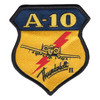
The red lightning bolt behind this A-10 is the Thunderbolt half of the name, a line that runs straight back to the Republic P-47 Thunderbolt of World War II. The Air Force named the Fairchild Republic A-10 the Thunderbolt II, and hardly anyone uses it. On the flight line and on the radio it is the Warthog, or just the Hog. This patch keeps the formal name in script and draws the airplane the way troops on the ground saw it, nose on and low. There is no squadron or wing on it, so it belongs to anyone who flew, fixed or worked alongside the jet.
The first YA-10 prototype flew on 10 May 1972, and Fairchild Republic had delivered 715 airframes by 1984. The 355th Tactical Training Wing at Davis-Monthan AFB took the first jets, and the 354th Tactical Fighter Wing at Myrtle Beach AFB reached initial operating capability in October 1977. The whole airplane was built around the GAU-8 Avenger, a seven-barrel 30mm rotary cannon, with two General Electric TF34 turbofans mounted high on the rear fuselage and roughly 1,200 pounds of titanium armor around the pilot, the bathtub. Its first combat came in Desert Storm in 1991, then Bosnia, Kosovo during Operation Allied Force, Operation Anaconda in Afghanistan in 2002 and Operation Iraqi Freedom in 2003. Fighter squadrons at Moody AFB, Davis-Monthan and Osan Air Base have flown it since.
The patch is a shield 3.5 inches wide and 4 inches tall, finished with a black merrowed edge and an iron-on backing. A navy blue band across the top carries "A-10" in gold block letters outlined in black. Below it the gold field shows the jet head-on in black outline, wings level, the two engine pods riding above the fuselage and stores hanging under both wings. The red bolt cuts diagonally behind the airplane, and "Thunderbolt" runs underneath in black script with a small "II" at the end. Engines high and wings straight, it is the picture a soldier in a fighting position remembers.
The A-10 community runs on a particular kind of pride. Pilots trained to work low and slow over troops in contact, where the gun and the titanium tub mattered more than speed. Maintainers kept a design that first flew in 1972 ready through Desert Storm and years of deployments to Afghanistan and Iraq. JTACs and forward air controllers learned exactly what a pair of Hogs could do for them on a bad day. Ground troops who heard the airplane overhead tend to remember that sound for the rest of their lives.
Mount it in a shadow box next to a squadron patch and a set of pilot wings, or put it on the jacket or vest you wear to a reunion. For a son or daughter who grew up hearing about the Hog, it is an easy way to hand down part of that story. It looks just as right on a range bag or a flight bag. Iron it on or stitch it down, and it will sit there for years.
Related Products


