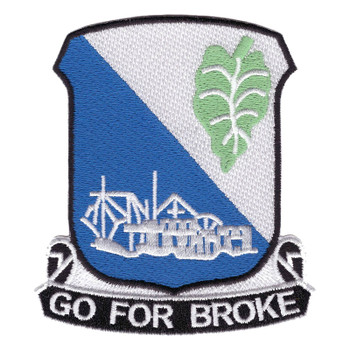
442nd Infantry Regimental Combat Team SSI Patch
- SKU:
- 1444
- MPN:
- 1444
- Width:
- 2.25 (in)
- Height:
- 2.88 (in)
- Depth:
- 0.08 (in)
- Backing:
- Iron On
- Edging:
- Cut Edge
- Era:
- World War II


Description
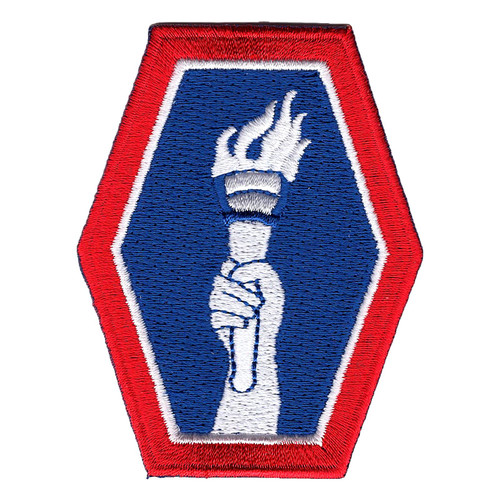
The hand and torch on this patch were drawn by one of the regiment's own, Sgt. Mitchie "Mitch" Miyamoto of the 3rd Battalion, after the men of the 442nd turned down the first design they were handed. That first version, approved in July 1943, showed a yellow arm holding a sword dripping blood, and nobody in the unit wanted it on his shoulder. Miyamoto's torch of liberty was adopted on December 16, 1943. The 442nd Regimental Combat Team was a Japanese American outfit, activated on February 1, 1943, and trained at Camp Shelby, Mississippi. It came out of the war called the most decorated unit for its size and length of service in American military history.
The combat team was built around the 442nd Infantry Regiment, the 522nd Field Artillery Battalion and the 232nd Engineer Combat Company, and in June 1944 the 100th Infantry Battalion from Hawaii joined it and fought on as its 1st Battalion. Its campaign credits run from Naples-Foggia and Rome-Arno through Southern France, the Rhineland, the Northern Apennines, Central Europe and the Po Valley. In October 1944 the regiment fought for Bruyeres in the Vosges Mountains, then pushed through the forest toward the 1st Battalion, 141st Infantry, the "Lost Battalion" of the 36th Infantry Division, cut off near Biffontaine. The 3rd Battalion broke through on October 30 and brought out 211 men, and the five days of fighting cost the 442nd about 800 casualties. In April 1945 the regiment helped break the Gothic Line in Italy, while the 522nd, the only Nisei unit to fight inside Germany, reached a Dachau subcamp near Hurlach on April 29 and helped free the prisoners there.
The patch is a tall hexagon with a red outer border, a thin white line inside it and a deep blue field. A white hand rises from the bottom edge and grips the torch, with fine blue stitching tracing the fingers and knuckles and a white flame curling off the top. Red, white and blue carried weight here, because many of the soldiers who wore it had families held in internment camps back home. Some men said the outline looked like a coffin when it first came out, and they wore it through every campaign anyway. The cut edge follows the hexagon at 2.25 by 2.88 inches.
Twenty-one men of the 442nd received the Medal of Honor, and the regiment's soldiers earned more than 4,000 Purple Hearts. "Go For Broke," the motto they took before leaving Mississippi, came from Hawaiian pidgin dice slang for putting everything on one roll. In 2010 Congress approved the Congressional Gold Medal for the 442nd and the 100th Battalion, presented the following year. The lineage is still in uniform: the 100th Battalion, 442nd Infantry is an Army Reserve unit headquartered at Fort Shafter, Hawaii, mobilized in 1968 during the Vietnam War and for Iraq in 2004.
With an iron-on backing it goes straight onto a jacket, vest or range bag, and it sits well in a shadow box next to a grandfather's ribbons or a photo from Camp Shelby. It also makes a fitting gift for the family of a Nisei veteran or for anyone who has stood at the Go For Broke Monument in Los Angeles. A small patch, with one of the longest award records of the war behind it.
Related Products