31st Infantry Regiment Patch

- SKU:
- 5006
- MPN:
- 5006
- Width:
- 2.64 (in)
- Height:
- 3.50 (in)
- Depth:
- 0.08 (in)
- Backing:
- Iron On
- Edging:
- Cut Edge







Description
The 31st Infantry got its polar bear in Siberia, guarding the docks at Vladivostok and the Trans-Siberian Railway from August 1918 into 1920. The regiment had been formed two years earlier, on 13 August 1916, at Fort William McKinley in the Philippine Islands, from cadre of the 8th, 13th, 15th and 27th Infantry. It was the first unit created under the National Defense Act of 1916. Thirty of its men died in Siberia, and the regiment came back to Manila as the Polar Bear regiment with a silver bear for its emblem. Its motto is Pro Patria, For Country.
In February 1932 the Polar Bears sailed to Shanghai and guarded part of the International Settlement through the Sino-Japanese fighting, which earned them the Yangtze Service Medal. When war came to the Philippines they covered the withdrawal onto the Bataan Peninsula, and at the surrender on 9 April 1942 they buried the colors and the Shanghai Bowl. About half of the roughly 1,600 men who went into captivity died there. Rebuilt and serving with the 7th Infantry Division, the regiment landed with the Inchon force in 1950 and fought east of the Chosin Reservoir, where Col. Allan MacLean and Lt. Col. Don C. Faith Jr. were killed and Faith received the Medal of Honor. In Vietnam the 4th Battalion served with the 196th Brigade and the Americal Division around Tay Ninh, Quang Ngai and Chu Lai, and the 6th Battalion fought in the Mekong Delta and the Plain of Reeds.
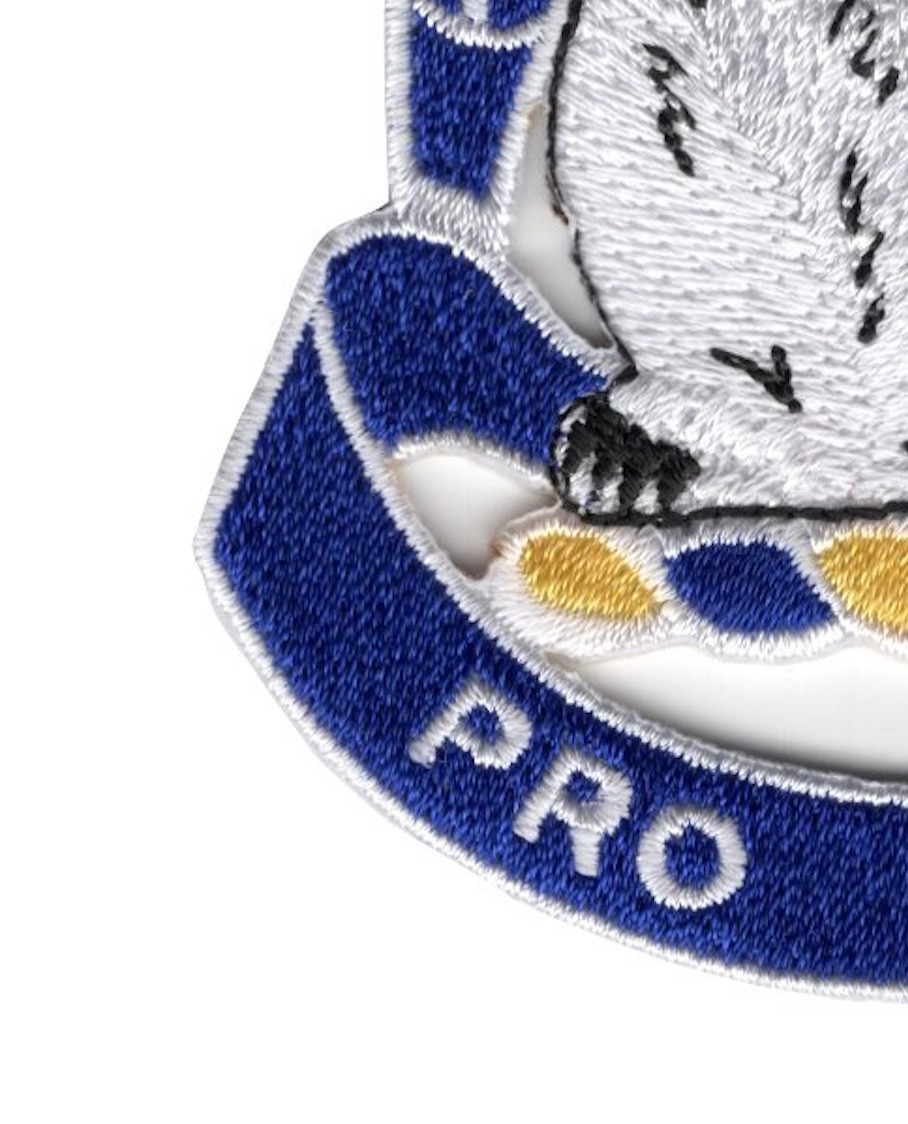
The patch is shaped around a white polar bear sitting upright, head turned over its shoulder, its fur picked out in black stitching. The bear sits on a twisted wreath of gold and blue above a blue scroll that reads PRO PATRIA in white letters. There is no background behind it, just the bear and the scroll, so the cut edge follows the outline. The bear is the Siberia story in one picture. It measures 2.64 by 3.5 inches with iron-on backing.
The Polar Bears carry a hard history and they carry it plainly. Bataan and Chosin are both on the regiment's record, and the Polar Bears remember both by name. Today the 4th Battalion, 31st Infantry is the regiment's battalion on the active rolls, serving with the 10th Mountain Division at Fort Drum, New York. A soldier there wears the same bear that went to Vladivostok in 1918. That line runs from Siberia to Shanghai, Bataan, Chosin, Tay Ninh and Fort Drum.
Put it in a shadow box with a photo from your time in the regiment, or on the vest you wear to a 31st Infantry reunion. It is also a good gift for the son or grandson of a Polar Bear who wants to know where the bear came from. The answer is Siberia, 1918.
Related Products