
302nd Fighter Squadron Tuskegee Airmen Embroidered Patch
- SKU:
- 125
- MPN:
- 125
- Width:
- 4.00 (in)
- Height:
- 4.00 (in)
- Depth:
- 0.08 (in)
- Backing:
- Iron On
- Edging:
- Merrowed Edge
- Era:
- World War II


Description
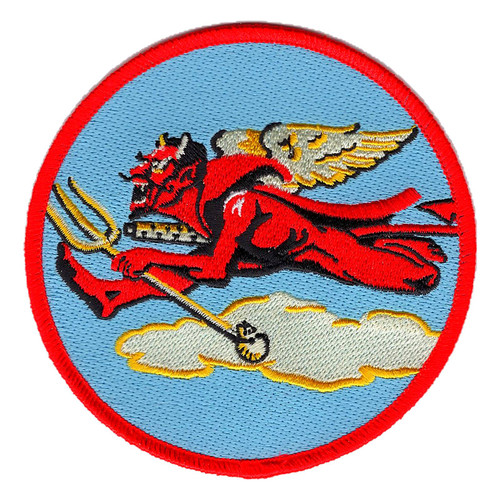
The winged red devil on this patch was approved as the 302nd Fighter Squadron's emblem on 2 November 1944, while the squadron was flying red-tailed P-51 Mustangs out of Ramitelli on the Adriatic coast of Italy. He is drawn flat out, wings spread and pitchfork leveled. The 302nd was one of the four squadrons of Tuskegee Airmen who went into combat in World War II. It flew under the 332nd Fighter Group and Col. Benjamin O. Davis Jr., and its devil is the squadron's own mark from the war years, and the same lineage still flies today.
The 302nd was constituted on 4 July 1942 and activated at Tuskegee Army Air Base, Alabama, on 13 October 1942 as part of the 332nd Fighter Group. Training moved to Selfridge Field, Michigan, in March 1943, with a stretch at Oscoda Army Air Field, before the squadron shipped out and landed at Taranto, Italy, in February 1944. It flew from Montecorvino and then Capodichino near Naples before settling at Ramitelli around 28 May 1944. Along the way the pilots went through the Curtiss P-40 Warhawk, the Bell P-39 Airacobra and the Republic P-47 Thunderbolt before getting the North American P-51 Mustang, and the 332nd escorted Fifteenth Air Force B-17 Flying Fortress and B-24 Liberator bombers. The squadron's combat service ran from 17 February 1944 to 20 February 1945, with campaign credit for Rome-Arno, Southern France, North Apennines, Rhineland and Air Combat, EAME Theater, and it was inactivated on 6 March 1945. Alongside it in the 332nd flew the 99th, 100th and 301st Fighter Squadrons.
The patch is a 4 inch by 4 inch round with a bright red merrowed edge around a sky blue field. The devil is stitched in red with black shading, gold horns and a fierce white-toothed grin, his wings worked in silver-white feathers tipped with gold. He carries a long gold pitchfork low across his body, and a white cloud trimmed in gold floats beneath him. The red border reads like the tail paint that gave the 332nd its Red Tails name. It has an iron-on backing and can be sewn down as well.
The Tuskegee Airmen trained at Tuskegee, Alabama, and went to war as the first African American military aviators in the Army Air Forces. Pilots, crew chiefs, armorers and mechanics of the 302nd kept Mustangs flying from a dirt-and-steel-plank strip on the Adriatic, and their record helped open every cockpit that came after them. The 302nd number came back in the Air Force Reserve in 1956 as an air rescue squadron, moved to the F-16 Fighting Falcon in 1987, and in 2007 moved to Elmendorf in Alaska to fly the F-22 Raptor with the 477th Fighter Group. A new rendition of the devil was approved the same year. Reservists in Alaska still wear a version of the emblem the Ramitelli squadron wore.
Put it in a shadow box beside a photograph of a grandfather in his flight jacket or a 332nd service record, or wear it on a vest to an air show, a Tuskegee Airmen chapter event or a Veterans Day parade. It also makes a thoughtful gift for a student who just finished a report on the Red Tails, or for an F-22 maintainer at Elmendorf who knows where the squadron number came from. The devil has been flying since 1944, and he still looks ready to go.
1 Review
-
302 nd Fighter squadron. Tuskegee airmen patch
The what! Again great art work in the design here . Popular patch have got it right again ! !
Related Products


