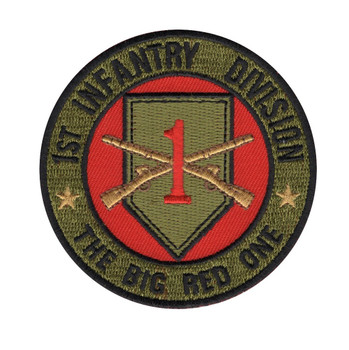
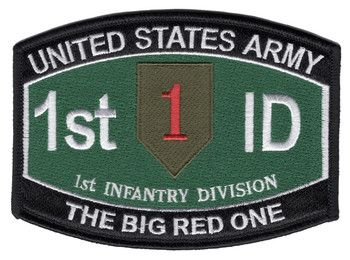
1st Infantry Division Big Red One Embroidered Patch – U.S. Army

- SKU:
- 4665
- MPN:
- 4665
- Width:
- 2.50 (in)
- Height:
- 3.75 (in)
- Depth:
- 0.08 (in)
- Backing:
- Iron On
- Edging:
- Cut Edge

Description
There is a reason they call it the Big Red One.
It's not just the patch — that bold crimson numeral standing alone on a field of olive drab, one of the most recognizable military insignia in the world. It's what that patch represents. A standard of excellence, a tradition of sacrifice, and more than a century of American soldiers answering the call when their country needed them most.
The 1st Infantry Division was born in the fire of the First World War. Organized in 1917 from the Regular Army's most experienced units, the 1st Division was the first American division to set foot in France, the first to enter the line under fire, and the first to take casualties in combat. On November 3, 1917, near Artois, soldiers of the Big Red One fired some of the opening rounds of American engagement on the Western Front. That day established a tradition that would define the division for the next hundred years: wherever the fight was hardest, the 1st Infantry Division would be there first.
In World War II, the Big Red One's record is nothing short of legendary. They fought across North Africa at Oran and El Guettar, stormed ashore in Sicily, and then — on a grey June morning in 1944 — led the assault on Omaha Beach in Normandy. The soldiers of the 1st Infantry Division faced some of the most ferocious German defenses of the entire war that day, taking devastating casualties and still pushing inland. Their courage at Omaha is now a permanent part of history, documented in film, literature, and the memories of those who survived. By the time Germany surrendered, the Big Red One had earned more campaign credits than almost any other U.S. Army division in the European Theater.
Vietnam tested the division in an entirely different kind of war. Deployed to III Corps Tactical Zone in the mid-1960s, the 1st Infantry Division operated deep in the jungles and rubber plantations north of Saigon. They fought in the Iron Triangle, a Viet Cong stronghold so heavily fortified that clearing it required some of the largest airmobile and ground operations of the war. They engaged in Operation Attleboro, Operation Cedar Falls, and Operation Junction City — relentless, grinding campaigns against an enemy who knew the terrain and used it expertly. The soldiers who served with the Big Red One in Vietnam did so with the same tenacity their fathers had shown on Omaha Beach: steadily, stubbornly, and with enormous courage.
The division continued to serve in the post-Cold War era, deploying to the Gulf War, to the Balkans during the peacekeeping operations of the 1990s, and repeatedly to Iraq and Afghanistan in the years following September 11th. Based at Fort Riley, Kansas — a post with its own deep roots in American military history — the 1st Infantry Division remains one of the Army's premier combat divisions today.
The Patch
The design of this patch is as intentional as it is iconic. Set against a shield-shaped background in army olive drab — a nod to the color of the uniform, the mud, and the field — a single bold red numeral "1" dominates the center. The shape of the shield tapers to a downward point at the bottom, a design element that has remained essentially unchanged since the division first adopted it in World War I. The red of the numeral is vivid and deliberate: it is the color of courage, of bloodshed, and of the pride every soldier who has worn this patch carries with them long after they hang up their uniform. Simple. Powerful. Unmistakable.
If you served with the 1st Infantry Division — whether at Fort Riley, in the jungles of Southeast Asia, on the sands of the Middle East, or anywhere the Army sent you under that red "1" — this patch is a piece of your story. It belongs on your vest, your jacket, or in a shadow box alongside the other honors of a life well and bravely lived. And if you're looking for a gift for someone who proudly wore the Big Red One, there are few things more meaningful you can give.
Carry that legacy with you. Honor the service that defined a generation. The Big Red One has always been first — make sure it has a place of honor in your collection.
Related Products