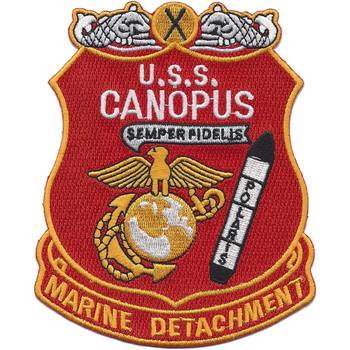
USS Canopus AS-34 US Navy Submarine Tender Patch

- SKU:
- 84
- MPN:
- 84
- Width:
- 3.75 (in)
- Height:
- 4.50 (in)
- Depth:
- 0.08 (in)
- Backing:
- Iron On
- Edging:
- Cut Edge

Description
She was built not for glory, but for the hidden work that makes a fleet unstoppable. The USS Canopus (AS-34)—a Polaris-era submarine tender—served in the long, quiet shadow of the Cold War, sustaining the U.S. Navy’s ballistic missile submarines as they formed America’s most powerful strategic deterrent. While carriers drew attention and cruisers patrolled the world’s flashpoints, Canopus operated behind the scenes, doing the patient, technical, relentless work that kept the “Silent Service” ready for anything.
Commissioned in 1965, Canopus joined the Navy at a moment when the oceans had become chessboards. The Soviet Union was expanding its submarine force, and America responded with the Polaris missile submarine fleet. These boomers could strike from anywhere—but only if tenders like Canopus kept them armed, repaired, supplied, and mission-ready. From her earliest years, she served forward in Rota, Spain, where she became a cornerstone of the Navy’s Submarine Squadron operations. Thousands of sailors rotated through her decks, working around the clock on sonar systems, missile tubes, engines, and the countless components that made the ballistic missile fleet the backbone of U.S. deterrence.
As the Cold War intensified, Canopus moved to Holy Loch, Scotland, a key strategic site where submerged patrols began and ended in secrecy. There, the ship supported Polaris and later Poseidon-equipped submarines whose crews operated under constant pressure, knowing their missions—though unseen and unspoken—were essential to preventing global conflict. Canopus became a second home to generations of sailors who lived among her workshops, wiring labs, machine shops, torpedo rooms, and missile handling decks. Their work was rarely celebrated, often classified, and absolutely vital.
When tensions surged in the 1980s, Canopus continued her work without fail. Whether supporting emergency repairs, rapid rearming, or full overhauls, she embodied the naval saying that “Logistics wins wars—even the ones no one ever sees.” Her service extended to Kings Bay, Georgia, where she helped stand up the Navy’s newest ballistic missile submarine base, marking a transition to the Trident era.
Sailors who served aboard her remember a ship defined by grit: long nights machining parts by hand, delicate electronics work demanding absolute precision, missile operations performed with near-religious care, and camaraderie forged through endless watches and impossible deadlines. Though she never fired a shot, Canopus helped maintain the peace for decades.
The USS Canopus AS-34 patch honors that quiet legacy of excellence. It represents the sailors who kept the nation’s most powerful submarines mission-ready, the strategic work done far from headlines, and a ship whose silent contributions helped shape the outcome of the Cold War.
Related Products