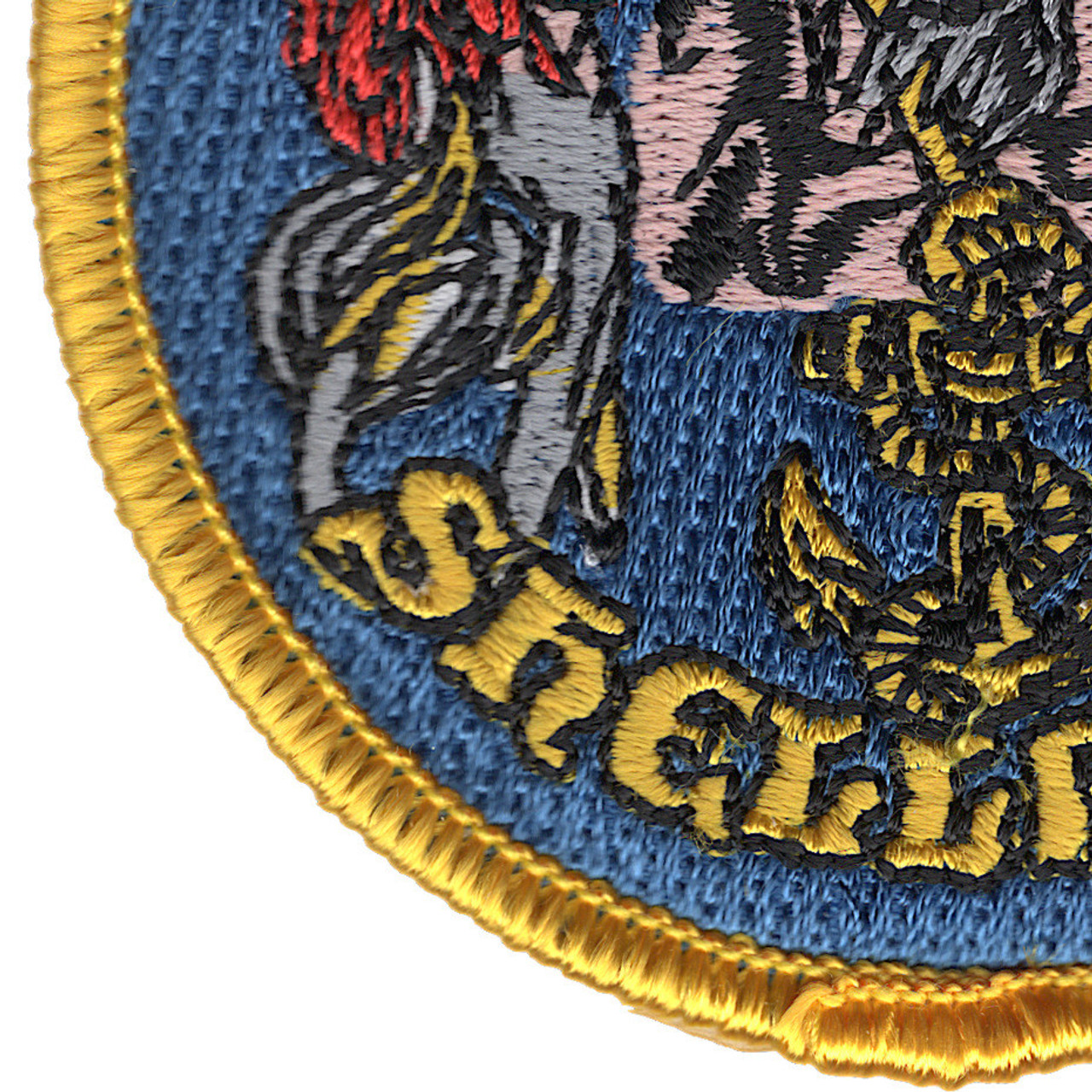
Shellback Ancient Order 3-Inch Patch

- SKU:
- 13342
- MPN:
- 13342
- Width:
- 3.00 (in)
- Height:
- 3.00 (in)
- Depth:
- 0.08 (in)
- Backing:
- Iron On
- Edging:
- Merrowed Edge




Description
Long before satellites tracked fleets and engines replaced sails, sailors marked their passage into the deeper brotherhood of the sea by crossing the equator. From this ancient maritime tradition emerged the Ancient Order of the Shellback, one of the oldest and most enduring rites in naval history. It is not a rank, a medal, or a qualification, but a shared experience that binds generations of sailors across centuries, oceans, and wars.
The ceremony traces its roots to the age of sail, when months at sea blurred time and distance, and crossing the equator was both a navigational milestone and a psychological one. Early mariners believed the equatorial waters belonged to King Neptune, ruler of the deep, and that only those properly initiated were fit to pass through his realm. What began as superstition evolved into tradition, carried forward as navies modernized but never fully let go of the sea’s old customs.
In the United States Navy, the Crossing the Line ceremony became a structured but symbolic transformation. Sailors who had never crossed the equator were known as Pollywogs, untested in Neptune’s domain. Upon crossing latitude zero, these sailors underwent a time-honored initiation overseen by Shellbacks—those who had crossed before—culminating in their acceptance into the Ancient Order. The ritual, theatrical by design, reinforced humility, camaraderie, and the reality that life at sea demands resilience and adaptability.
Throughout the twentieth century, Shellback ceremonies took place during some of the most consequential moments in naval history. Sailors earned their Shellback status aboard battleships, aircraft carriers, destroyers, and submarines during World War II, Korea, Vietnam, the Cold War, and beyond. Even as ships transitioned from steam to nuclear power and missions shifted from fleet battles to global presence, the crossing remained a constant reminder that sailors are part of something older than any single conflict.
The Shellback identity is deeply cultural. It represents endurance through monotony, humor in hardship, and unity forged far from shore. The ceremony is remembered not for spectacle alone, but for what it creates afterward—a shared story that can instantly connect sailors who may have served decades apart. A Shellback does not need to explain the meaning; it is understood the moment the term is spoken.
Unlike medals awarded for singular acts, the Ancient Order of the Shellback reflects the quiet truth of naval service: long days, shared spaces, and the ocean as both workplace and adversary. It honors not conquest, but continuity—the passing down of tradition from one watchstander to the next, across hemispheres and generations.
Related Products