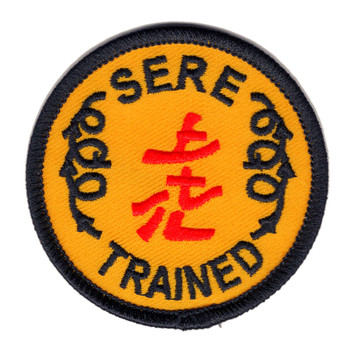
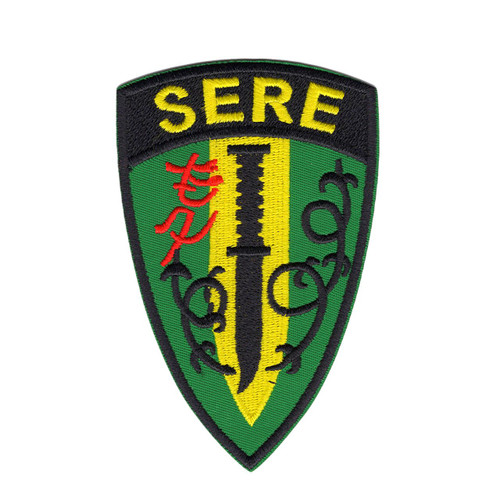
Survival Evasion Resistance Escape SERE School Patch Knife Slashing Barbed Wire
- SKU:
- 9087
- MPN:
- 9087
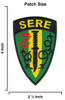
- Width:
- 2.50 (in)
- Height:
- 4.00 (in)
- Depth:
- 0.08 (in)
- Backing:
- Iron On
- Edging:
- Cut Edge


Description
Survival, Evasion, Resistance, and Escape—known throughout the U.S. military simply as SERE—is not a course about heroics. It is a discipline rooted in realism, humility, and the acceptance that even the most capable service member may one day find themselves alone, hunted, captured, or cut off from support. SERE exists to prepare men and women for that moment, long before it ever arrives.
The origins of SERE training trace back to the experiences of American prisoners of war during World War II and the Korean War, where harsh captivity revealed gaps in preparation that could no longer be ignored. Lessons learned from those conflicts—often paid for in suffering—were consolidated into a formal program designed to ensure future service members would not face isolation or captivity unprepared. The school institutionalized hard truths: survival is a skill, resistance is learned, and endurance is trained.
SERE instruction became essential for aviators, special operations forces, and others operating in high-risk environments where the possibility of isolation was not theoretical. Students learned how to survive with minimal resources, evade pursuit across hostile terrain, resist exploitation under captivity, and escape when opportunity presented itself. Each phase was designed to test not just technical knowledge, but judgment, discipline, and emotional control under stress.
Resistance training, in particular, became one of the most psychologically demanding experiences in U.S. military education. It emphasized lawful conduct, adherence to the Code of Conduct, and the preservation of identity under pressure. The goal was never to create defiance for its own sake, but to instill resilience—teaching service members how to endure without surrendering who they are or what they represent.
Through the Cold War and into modern conflicts, SERE evolved alongside the battlefield. From jungle to desert, arctic to maritime environments, the school adapted its scenarios to reflect real-world conditions faced by U.S. forces. Whether during Vietnam, Desert Storm, or the long campaigns of the Global War on Terror, SERE-trained personnel carried forward a mindset shaped by preparation rather than assumption.
The culture surrounding SERE is quiet and deeply respected. Those who have attended do not speak of it casually, not out of secrecy, but out of understanding. The training is personal, internal, and transformative. It is remembered not as an ordeal, but as a threshold—one that reinforces the reality that survival is a responsibility, not a guarantee.
Today, SERE School stands as a cornerstone of professional military readiness, ensuring that those who serve are prepared for the worst day of their career, not just the best.
Related Products